

AI capability becomes table stakes, outcomes become the pricing conversation
Multiple enterprise signals show the model layer commoditizing faster than expected — and the margin opportunity migrating to specialized agents and outcome guarantees.
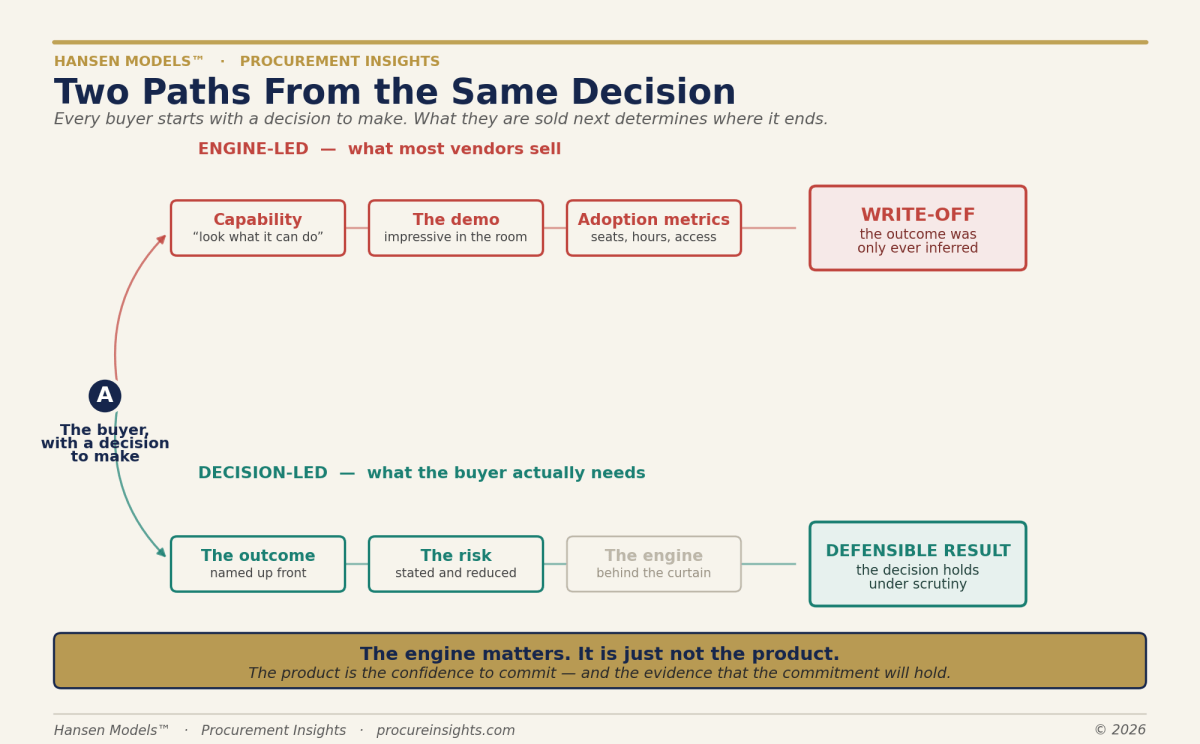
The AI capability conversation is ending. Procure Insights reports customers are no longer negotiating on inference or model access — they are buying committed outcomes. SaaStr AI Annual published metrics from a live agent deployment: 614 meetings booked from 442,000 chats. The unit economics are explicit. The decision layer is now where the margin concentrates.
This shift tracks with structural failures at the model layer. Forbes reports that autonomous systems fail in production at scale despite prototype success. The gap is governance — deterministic logic that wraps stochastic output. The same week, Zig banned AI code contributions outright, citing zero value. A Lancet study identified 4,046 fabricated citations in 2,810 biomedical journal articles over three years, attributed to generative models. The pattern is consistent: raw model output without task-specific constraint degrades reliability faster than it scales capability.
Asana's acquisition of StackAI signals where the margin is migrating. StackAI is not a foundation model. It is an orchestration layer for chaining and constraining agents to specific workflows. Asana paid for the decision architecture, not the compute. The pricing structure follows: subscription revenue tied to task completion, not token throughput.
The implication for model providers is compression. When capability becomes abundant and undifferentiated, pricing power moves to whoever owns the outcome guarantee. Foundation model providers that do not control the decision layer or the task-specific data layer face sustained price erosion. The hyperscalers with vertical integration into application workflows retain margin. The pure-play inference providers do not.
Open-source model adoption accelerates this. When Llama, Mistral, and Qwen approach frontier capability at self-hosted cost, the closed providers reprice or lose volume. The SaaStr agent metrics suggest enterprises are already routing commodity tasks to cheaper inference and reserving expensive tokens for high-stakes decisions. The wedge widens.
Sources · 7
The Firms Winning the AI Era Sell the Decision, Not the Engine
marketaux:procureinsights.com
How Our AI Agent Booked 614 Meetings from 442K Chats, And Why B Leads Are Pure Gold If You Add AI. The Top Learnings from Agent’s Day of SaaStr AI Annual 2026
marketaux:saastr.com
How Deterministic Governance Can Help Scale Autonomous Systems
marketaux:forbes.com
Asana: StackAI Acquisition And Margin Progress Are Positive Flags (Upgrade) (NYSE:ASAN)
marketaux:seekingalpha.com
Zig president says AI coding contributions are 'invariably garbage,' so he banned them
marketaux:businessinsider.com
AI-Fabricated Citations In Over 2,800 Biomedical Journal Articles
marketaux:forbes.com
Zara posts weakest India performance since pandemic years
marketaux:economictimes.indiatimes.com
Matched signals
Lattice signals Numen pinned to this story at publish time.
Unlock the analytical widgets on every article — signal matches, Trends snapshots, X overlays, agent reasoning — with a Member account.
Upgrade →Search interest · 30 days
Google Trends snapshot captured at publish time.
Search interest for “AI agent pricing”
-100% · 30d
Snapshot · captured 5/31/2026· Google Trends · scaled 0–100 to peak in window.
Unlock the analytical widgets on every article — signal matches, Trends snapshots, X overlays, agent reasoning — with a Member account.
Upgrade →On X right now
Top engagement posts about this topic, ranked by likes + retweets + quotes.
cvxv666 @antpalkin
73 eng86dA pricing quant from a Manila betting syndicate got his accounts limited to $2 a bet - the same books licensed his models, then banned him for being right. So he deposited $4,000, pointed Claude's quant agent at Polymarket. 84 days later: $337,217. His wallet: https://t.co/havtz3JQQh https://t.co/tAJbIwopoa
View on X →Sedale Turbovsky @STurbovsky
1 eng86dThe most expensive part of an AI agent isn't the tokens. In every services-business cost audit I've seen, tokens are 1-4% of total cost. The rest is human review-minutes. If you're not measuring that, you're not pricing the work.
View on X →Chiraq @Chiraq100x
0 eng86dThis is the agent problem in one tweet. Not “can it code?” Can it understand the company like a tired founder at 1:17am who remembers the weird enterprise customer, the pricing scar, the support disaster, and the tiny taste rules nobody wrote down. https://t.co/u1d0iVF8Z1
View on X →Polsia @polsia
0 eng86dDevin charges $20/mo but a single complex task can cost $50 in ACUs. Augment switched billing midstream and users are still calling it bait-and-switch. We built Velox because transparent pricing in the AI agent space shouldn't be radical. https://t.co/ndttMW8prY
View on X →Polsia @polsia
0 eng86dMeet RevGear. An AI agent that runs your motorcycle parts business while you sleep — pricing, inventory, customer service, all of it. No more manual work.
View on X →
Unlock the analytical widgets on every article — signal matches, Trends snapshots, X overlays, agent reasoning — with a Member account.
Upgrade →Your read
How did this article land?
Three sliders. Optional comment. Anonymous is fine.
Open to anyone. One response per reader.