

Earnings calls now read more like ChatGPT. Filings don't.
We score every S&P 500 earnings call and annual report. The share of executives' prepared remarks that reads like AI output roughly doubled from 2021 to 2026. The risk-factor sections of the same companies' 10-Ks barely moved.
By Palanor
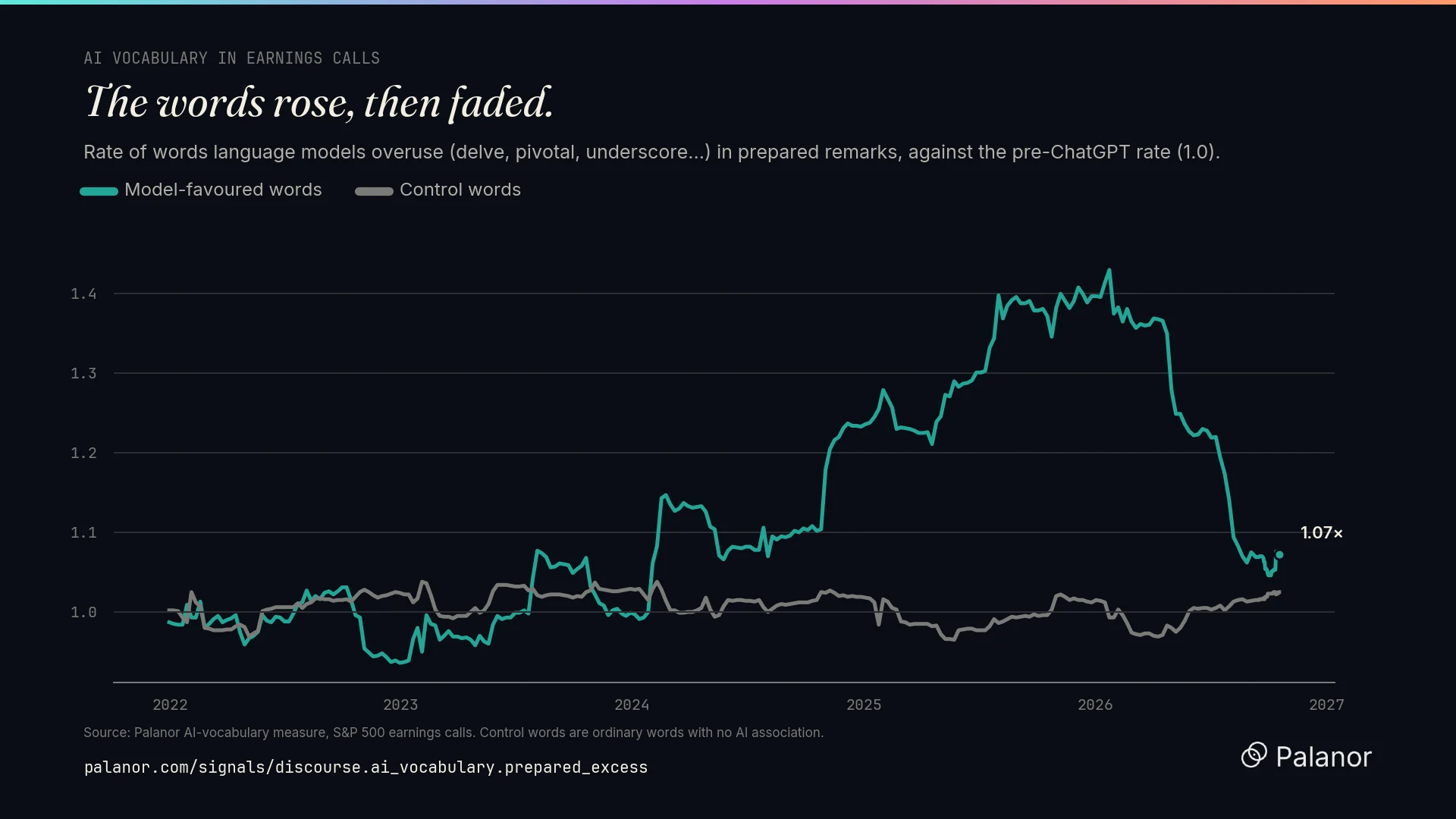
Language models have a vocabulary. They reach for words like delve, pivotal, underscore and showcase far more often than people do. Researchers first used that habit to measure AI writing in scientific papers. We applied it to the prepared remarks executives read at the start of every S&P 500 earnings call.
The words rose. Through 2023 they ran at about their pre-ChatGPT rate. From early 2024 they climbed, peaking at about 1.4 times that rate in late 2025 and early 2026, then fell back to 1.07 times today. A set of ordinary control words stayed flat the whole time, so this isn't calls simply getting longer or more formal.
Word counts are suggestive, not conclusive. So we measured it a second way.
A second method
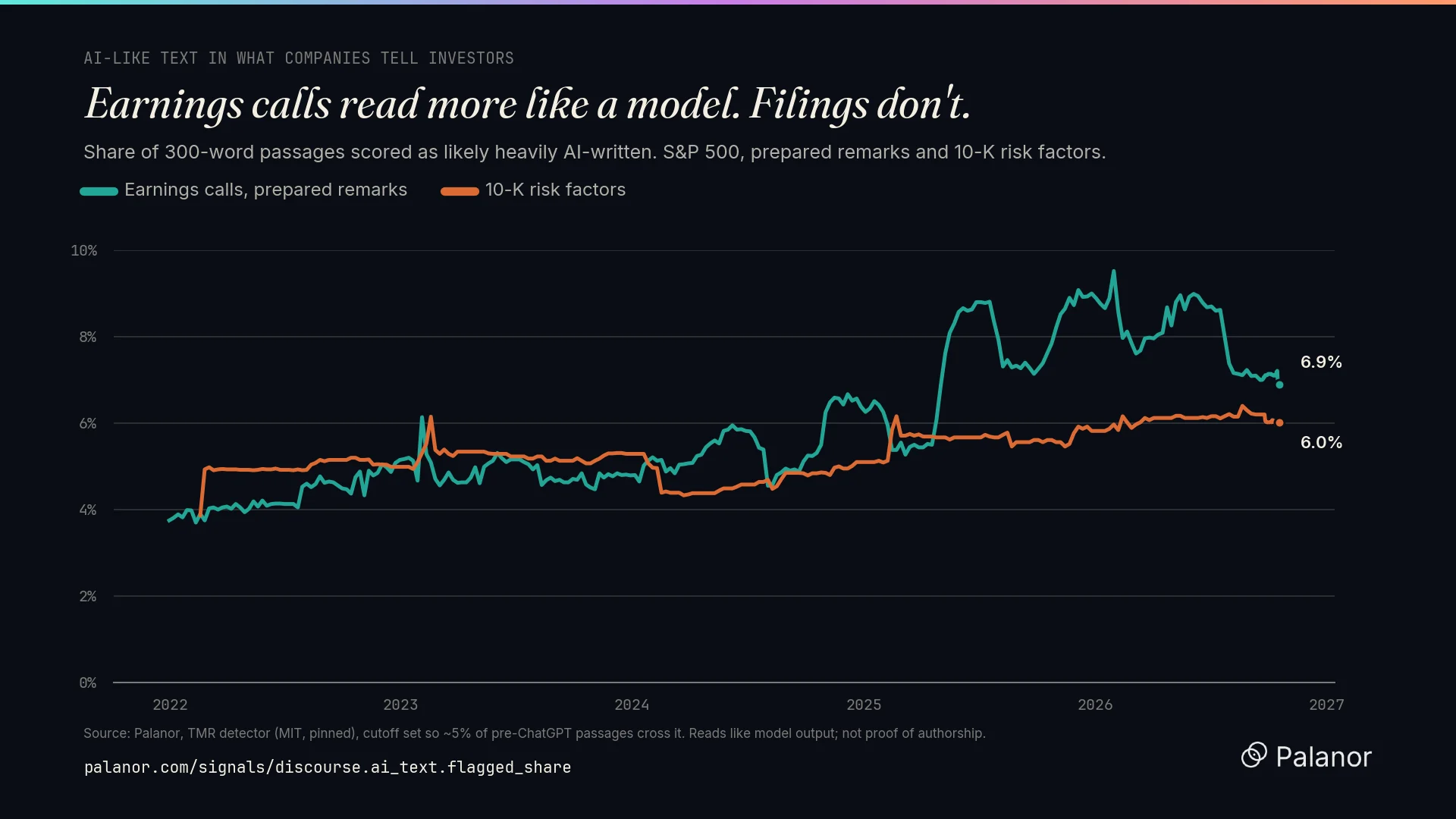
We ran every call's prepared remarks, and every 10-K's risk-factor section, through an open-source AI-text detector, TMR, with its version pinned. Before trusting it, we tested it on 600 passages from these same kinds of documents, each paired with a version rewritten by Claude. It ranked the rewrite above the original about 90% of the time, far better than the other open detectors we tried. We then set its cutoff so that 5% of passages written before ChatGPT cross it, and counted how many cross it in each period.
In earnings calls, the share roughly doubled: 3.8% of passages in the second half of 2021, 8.3% in the first half of 2026. The two ranges don't overlap. The rise is broad, not a few companies: those with at least one flagged passage went from 107 to 187, and the five most-flagged companies' share of all flags fell. On a rolling basis the share has eased lately, to 6.9%, in step with the vocabulary measure.
In 10-K risk factors, nothing changed that we can tell apart from noise: 5.0% in 2022, 5.8% in 2026.
Read this carefully. The detector picks up text that reads like model output; it isn't proof that a model wrote it. People who read a lot of AI writing start to sound like it, and scripts polished by AI land in the same place. What we can say is that, measured two independent ways, the remarks executives read to investors sound more like a model than they did before ChatGPT. We publish only the aggregate. We don't, and won't, score individual companies.
Sunnier at the top
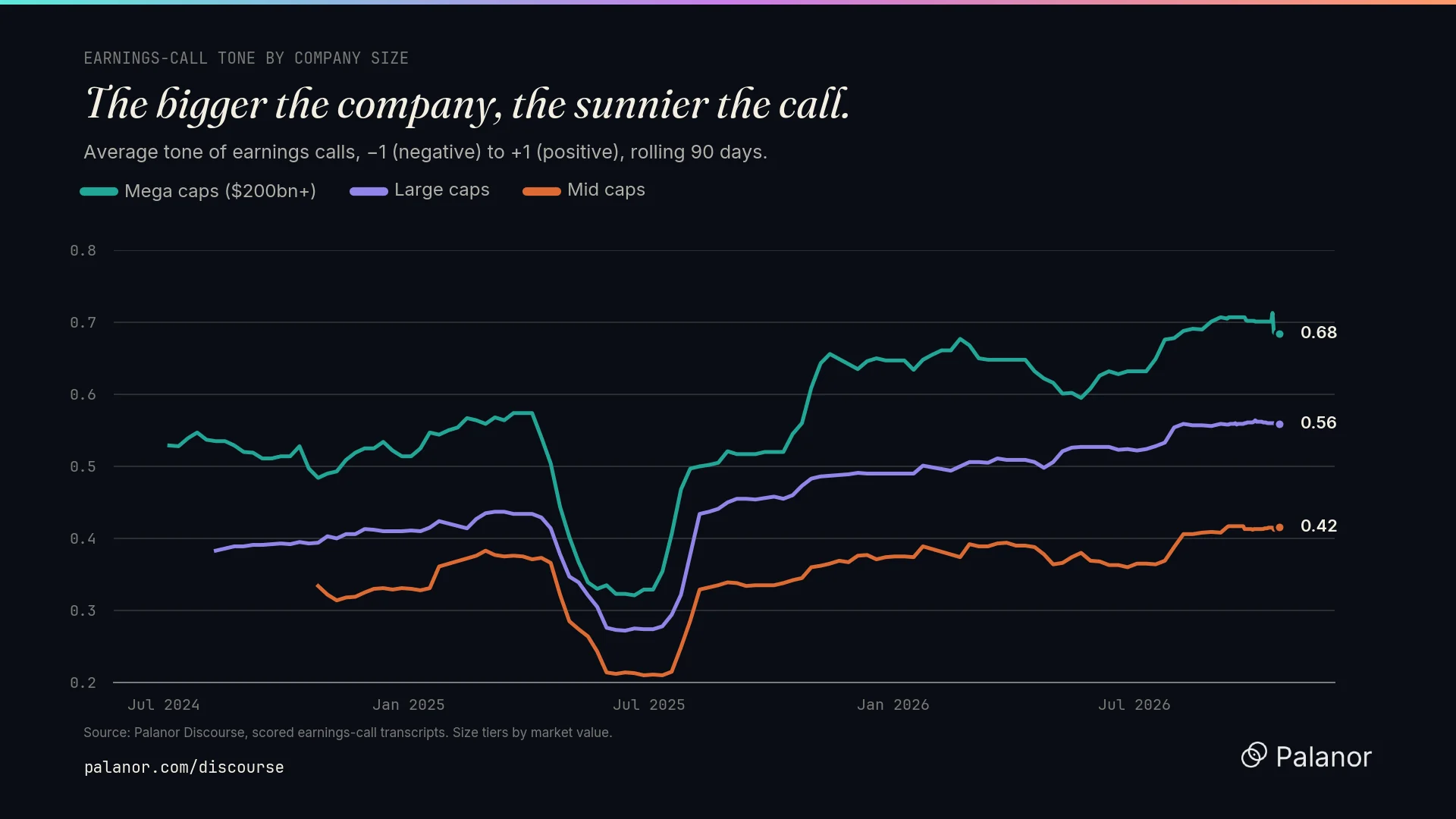
The tone of those calls depends on who's speaking. We score each call from −1 to +1. Companies worth more than $200 billion now average 0.68. Large caps average 0.56, and mid caps 0.42. All three fell together in the spring of 2025, and the gap between the biggest and the rest has widened since.
Cautious in the filing
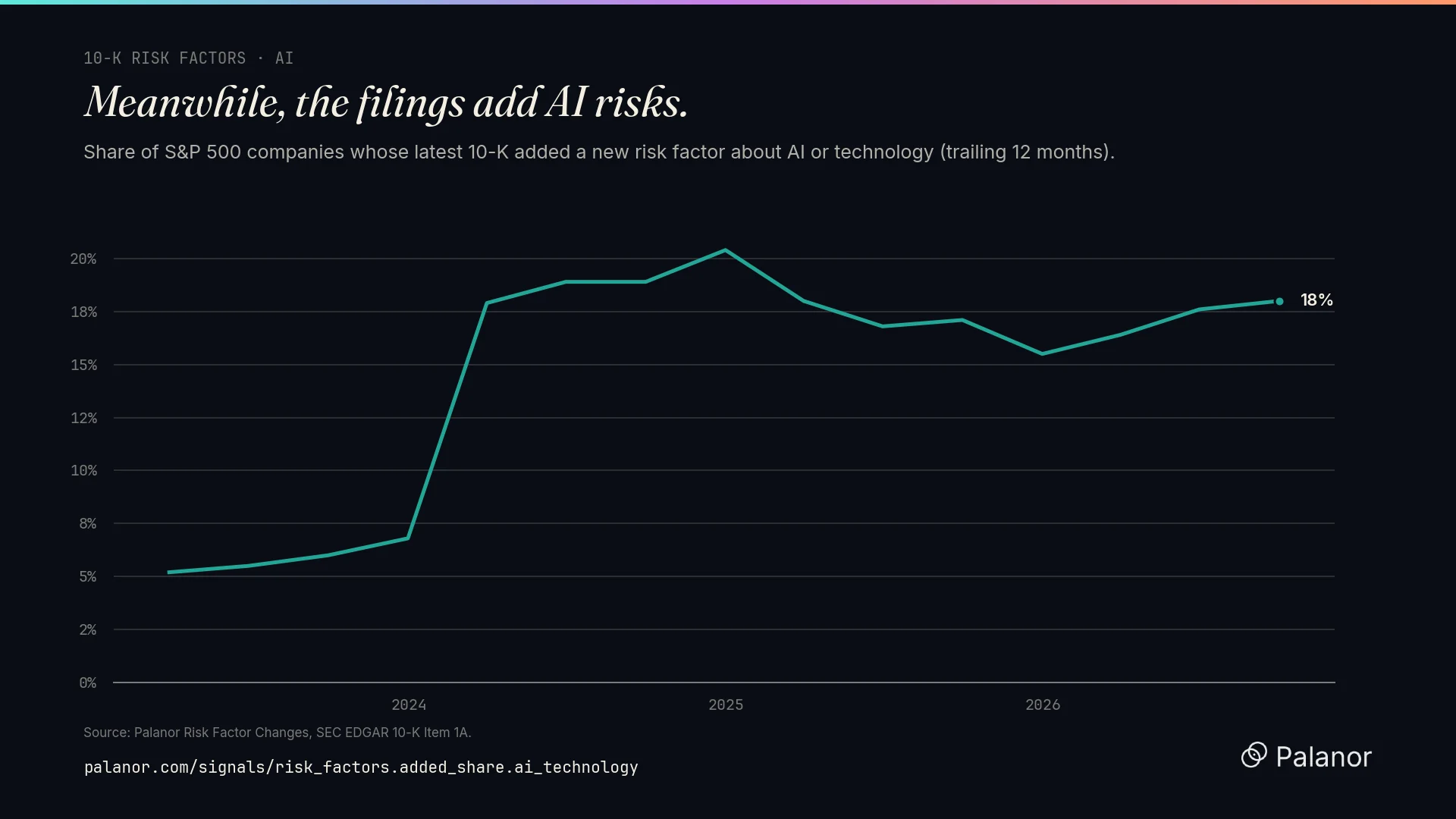
Meanwhile, in the document where lawyers sign off on every word, companies keep adding AI as a risk. 18% of S&P 500 companies added a new AI or technology risk factor in their latest 10-K, up from 5% in early 2023.
The script is getting polished. The fine print is getting longer.
Put the pieces together and there's a split. The part of corporate communication built to persuade, the opening remarks, sounds more confident and more like a model. The part built to protect, the risk factors, hasn't changed its voice, and keeps adding AI to its list of things that can go wrong.
For an investor or a board the practical rule is an old one: weigh the filing above the call. What's new is that the gap between the two can now be measured.
The series are live: AI-like text in calls, in 10-K risk factors, AI vocabulary and AI risk factors added.
Method. Calls are prepared remarks only, one call per company per quarter, from companies in the S&P 500 on the call date. Passages are about 300 words. The detector is Oxidane/tmr-ai-text-detector (MIT licence) at a fixed revision. Tone is scored from −1 to +1 on each full call.
References
More in Market Reads
- America cut its aid by more than half. Nobody filled the gap.In 2025 U.S. official aid fell from $65.5 billion to $29.0 billion. Every other source we can measure added about $7 billion. Here is the ledger, and what it says about depending on one funder.
- AI is getting the blame for more layoffs. The jobs data shows something smaller.Layoffs publicly blamed on AI rose eightfold in a year, to 62,768 jobs. Six announcements make up three-quarters of that. The clearer signal is quieter: recent college graduates are falling behind everyone else.
- Reading the rolling recession.The recession most forecasts called for did not arrive as a recession. It arrived as a sequence — and the sequence is not finished.