
America cut its aid by more than half. Nobody filled the gap.
In 2025 U.S. official aid fell from $65.5 billion to $29.0 billion. Every other source we can measure added about $7 billion. Here is the ledger, and what it says about depending on one funder.
By Palanor
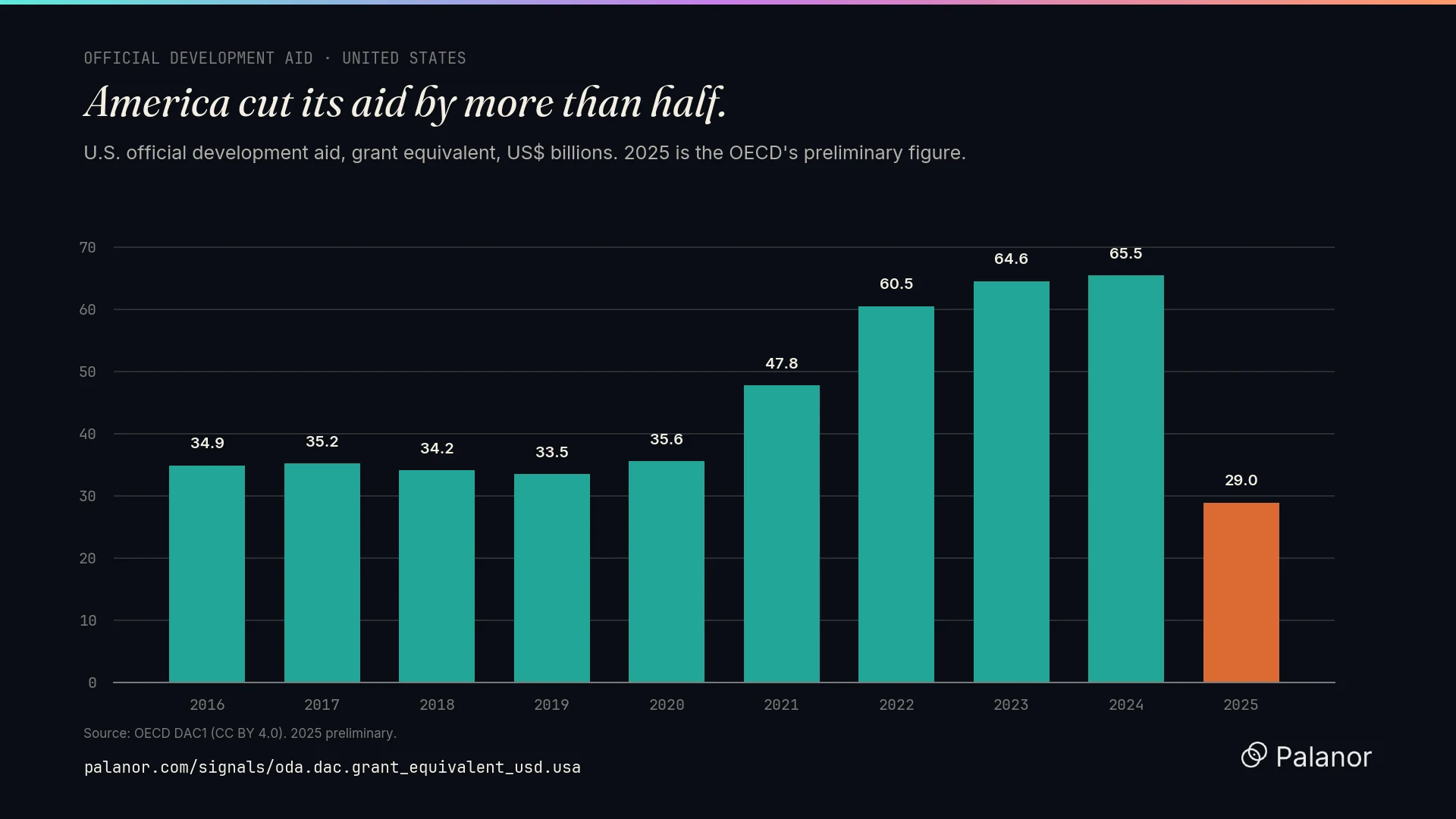
In 2024 the United States gave $65.5 billion in official development aid, counted the way the OECD now counts it. In 2025 it gave $29.0 billion. That is a cut of $36.5 billion, or 56%, in one year. The OECD's 2025 figure is preliminary, but a second source agrees: the payments U.S. agencies report to IATI, the open registry of aid spending, add up to $28.7 billion for 2025, 99% of the OECD number.
The obvious question is who stepped in. We looked across every source that publishes enough to answer it. The short answer is nobody, at least not at anything like the scale of the cut.
The ledger
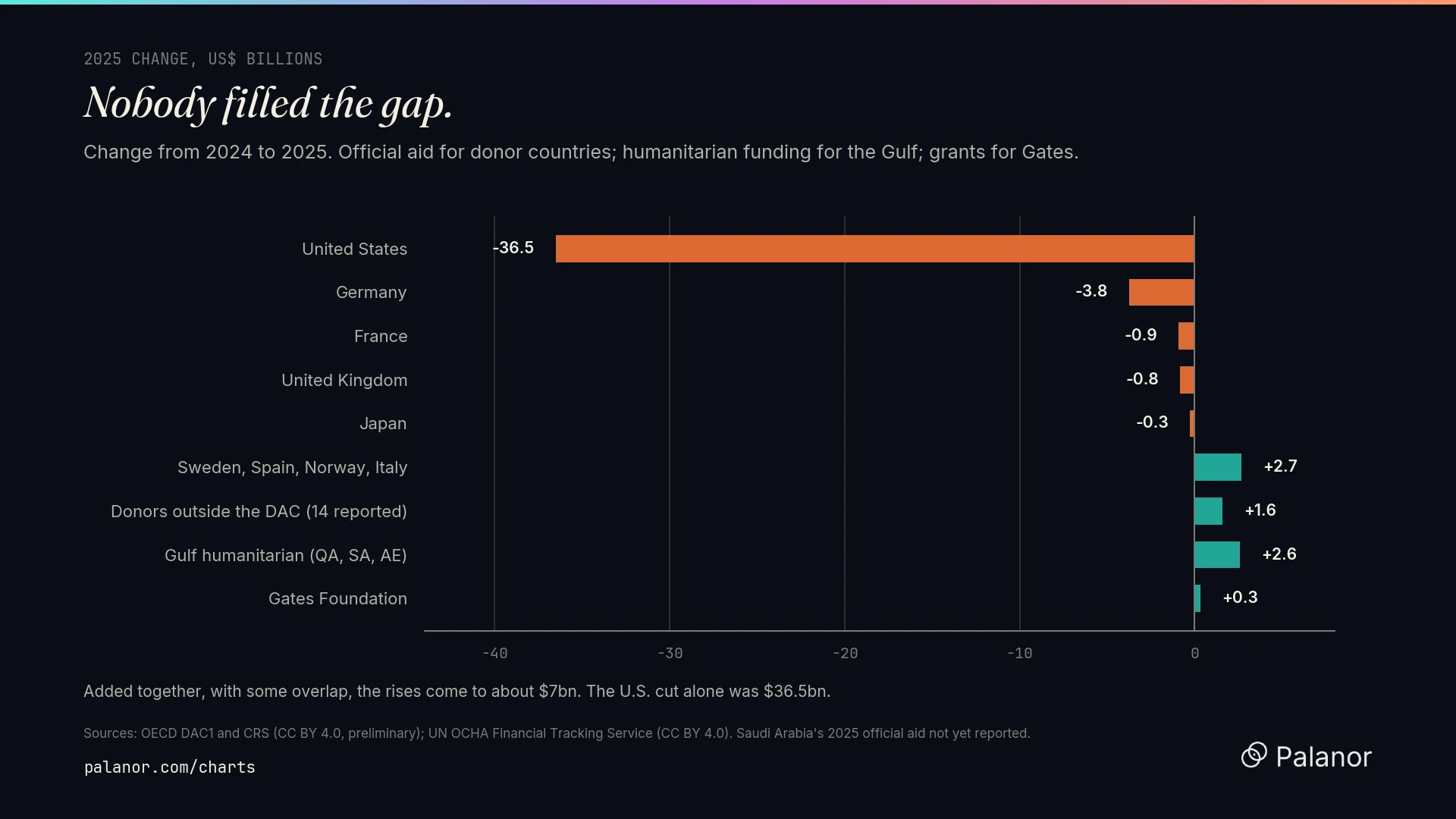
Start with the other rich donors, the members of the OECD's Development Assistance Committee. Their aid fell $40.8 billion in total, so the rest of the club cut $4.3 billion on top of the U.S. Germany cut $3.8 billion, France $0.9 billion, the UK $0.8 billion and Japan $0.3 billion. Sweden, Spain, Norway and Italy went the other way, adding $2.7 billion between them.
Outside that club, 14 of the 18 other countries that report their aid to the OECD have filed 2025 figures. Together they added $1.6 billion, most of it from the UAE (+$1.3 billion). Saudi Arabia, the second-largest of these donors in 2024 at $5.6 billion, hasn't reported yet. Even if it had doubled its aid, the total would still be a fraction of the U.S. cut.
Philanthropy moved, but modestly. The Gates Foundation's development grants rose $0.3 billion, to $5.1 billion. A total for all foundations in 2025 doesn't exist yet; the OECD's complete foundation figures end in 2023.
Humanitarian funding tells the same story, more sharply. Humanitarian funding tracked by the UN fell $8.8 billion in 2025. The U.S. alone cut $10.0 billion, from $14.0 billion to $4.0 billion. Qatar, Saudi Arabia and the UAE added $2.6 billion between them.
What the cut looks like
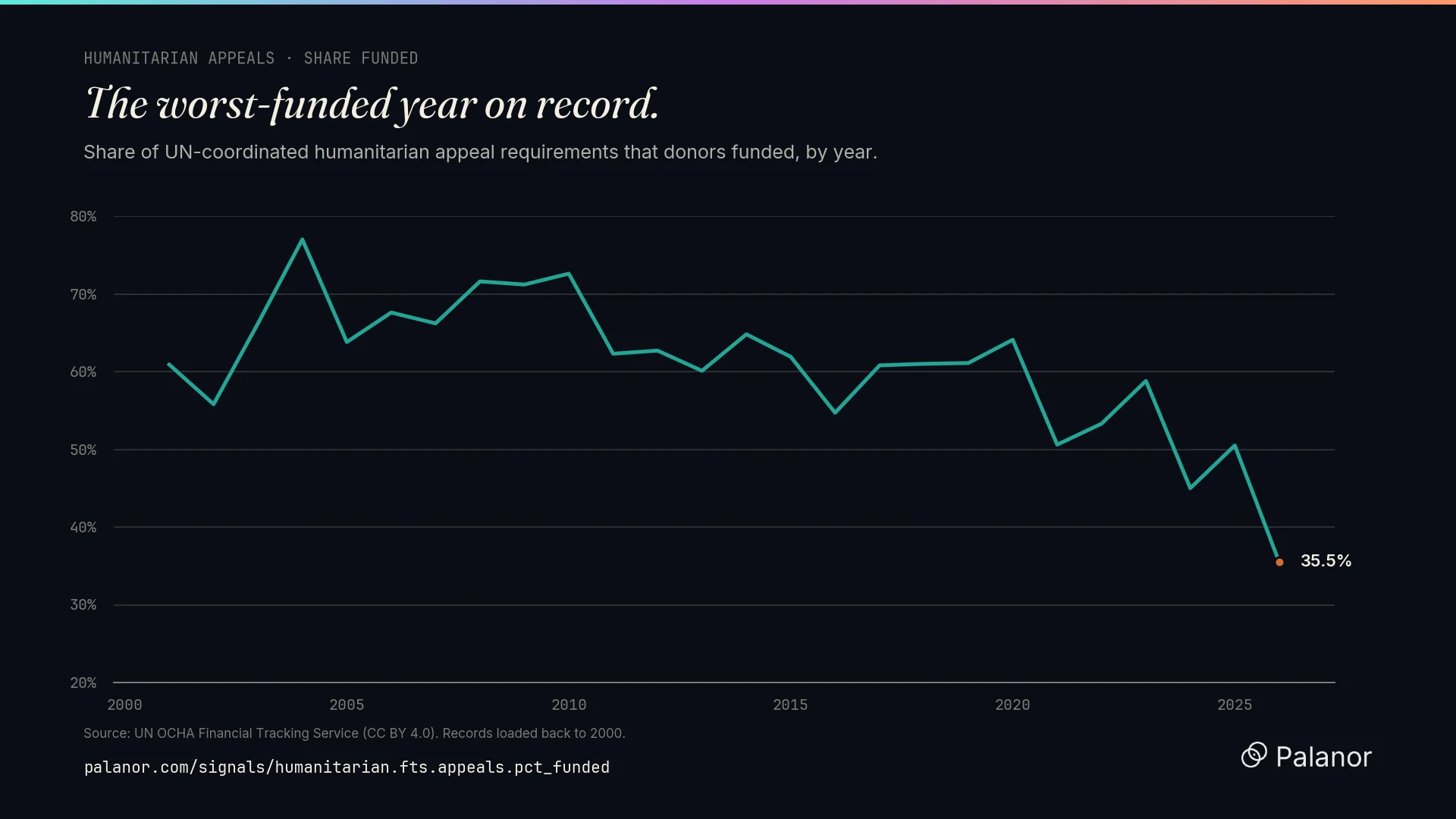
The clearest single number comes from humanitarian appeals, the UN-coordinated requests for emergencies from Sudan to Gaza. In 2025 donors funded 35.5% of what those appeals asked for. That is the lowest share in records back to 2000. In 2024 it was 50.5%.
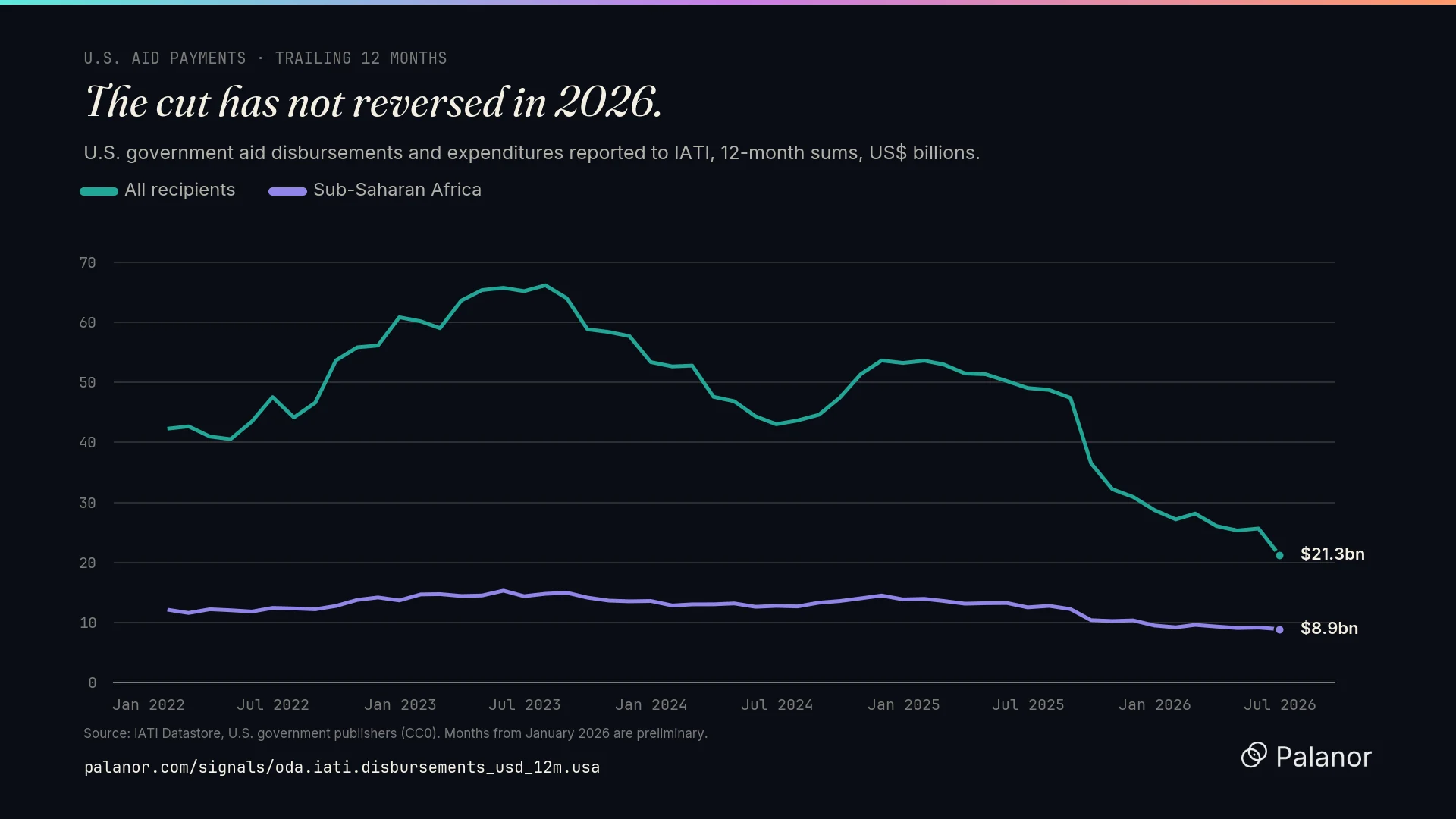
The cut wasn't spread evenly. U.S. aid to sub-Saharan Africa fell 31% in 2025, against 46% for U.S. aid overall, so Africa's share of U.S. aid rose from 26% to 33%. In dollars, about four-fifths of the cut landed outside Africa. And the six other large publishers we track month by month, the World Bank, the Global Fund, Gavi, the EU, Germany and the UK, cut their own spending in sub-Saharan Africa by $1.6 billion. Nobody filled the gap there either.
Has it turned? Not yet. In the twelve months to June 2026, U.S. agencies reported $21.3 billion in aid payments, down from $49.1 billion a year earlier. The 2026 months are preliminary and will rise as late reports arrive, but there's no sign of a rebound.
What we can't see yet
We can't yet measure the human cost. The health outcomes we track, child mortality and vaccination coverage, are published with a lag and run only to 2024. Any claim about lives lost in 2025 is, for now, a model rather than a measurement. We'll chart those series as each year lands.
We also can't see China. The best public source on Chinese development finance, AidData's dataset, ends in 2021.
The steward's read
This isn't a story about generosity. It's a story about concentration.
In 2024 the U.S. supplied about 30% of all the aid from the big donor countries. When that funder left, there was no second source large enough to step in, and no way to bring one in quickly. Every institution that depends on one customer, one lender or one supplier carries the same risk. It just rarely gets tested this cleanly.
The useful question for a board isn't whether the cut was right. It's what would happen to you if your largest source of money halved next year, and who, specifically, would make up the difference. If the honest answer is "someone would step in," this is what that assumption looked like when it was tested.
Every figure here is live in Palanor and updates as donors report: U.S. official aid, U.S. aid payments, monthly, and humanitarian appeals funded.
References
- OECD DAC1, official development assistance (preliminary 2025), CC BY 4.0
- OECD Creditor Reporting System, private philanthropy, CC BY 4.0
- UN OCHA Financial Tracking Service, CC BY 4.0
- IATI Datastore: U.S. government, FCDO, BMZ, European Commission (DG INTPA), World Bank, Global Fund and Gavi publishers
- AidData, Global Chinese Development Finance Dataset v3.0, ODC-By
More in Market Reads
- Earnings calls now read more like ChatGPT. Filings don't.We score every S&P 500 earnings call and annual report. The share of executives' prepared remarks that reads like AI output roughly doubled from 2021 to 2026. The risk-factor sections of the same companies' 10-Ks barely moved.
- AI is getting the blame for more layoffs. The jobs data shows something smaller.Layoffs publicly blamed on AI rose eightfold in a year, to 62,768 jobs. Six announcements make up three-quarters of that. The clearer signal is quieter: recent college graduates are falling behind everyone else.
- Reading the rolling recession.The recession most forecasts called for did not arrive as a recession. It arrived as a sequence — and the sequence is not finished.