

AI is getting the blame for more layoffs. The jobs data shows something smaller.
Layoffs publicly blamed on AI rose eightfold in a year, to 62,768 jobs. Six announcements make up three-quarters of that. The clearer signal is quieter: recent college graduates are falling behind everyone else.
By Palanor
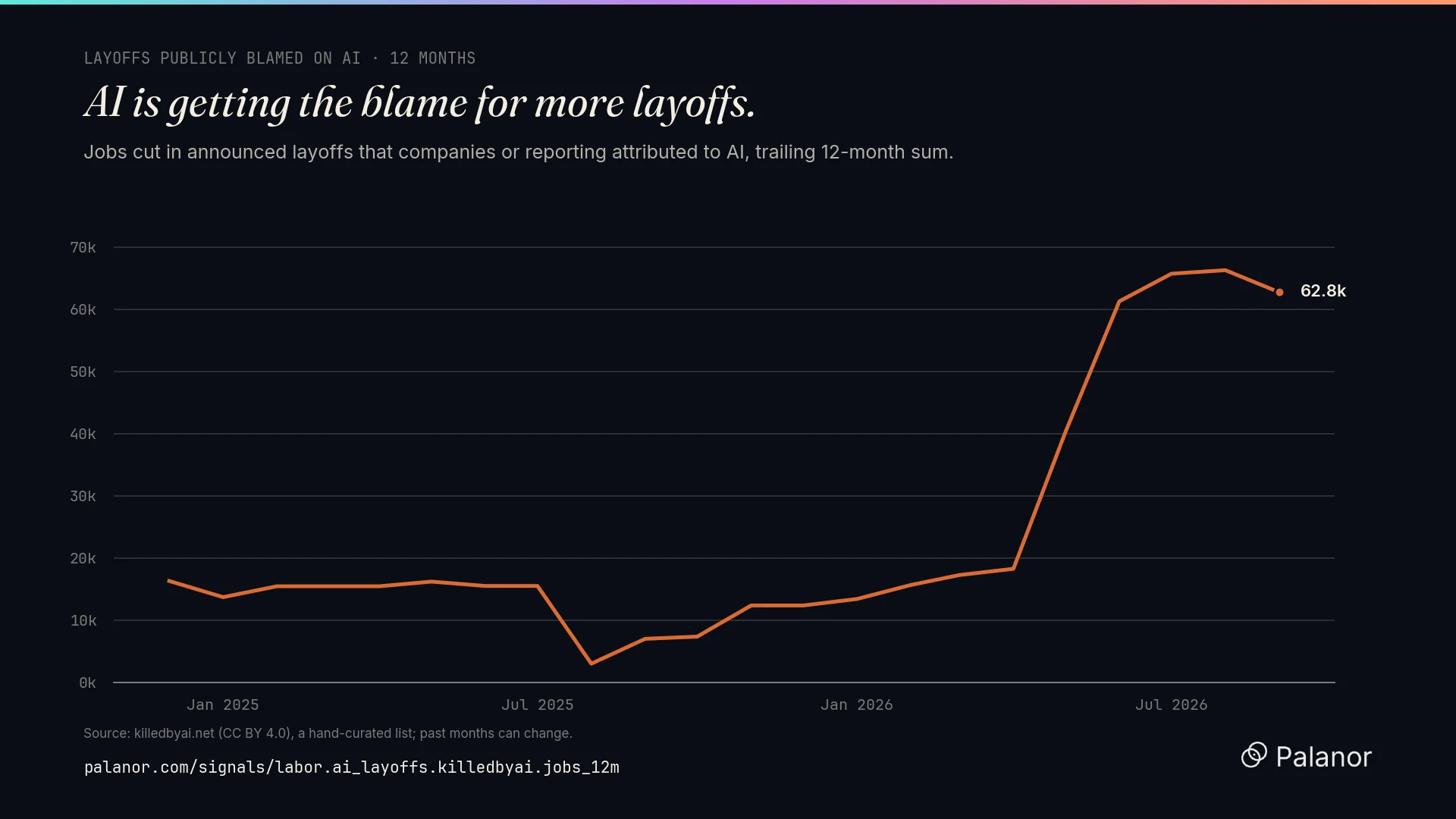
In the twelve months to September 2026, companies announced layoffs of 62,768 jobs that they, or the reporting around them, put down to AI. A year earlier the same count was 7,386. That's the tally kept by killedbyai.net, a hand-curated list that we track as a signal.
Look inside the number and it shrinks fast. It covers 28 announcements. Oracle's 21,000 cuts in June are a third of the total on their own. Add Meta (8,000), HP (5,000), PayPal (4,760), Block and Cisco (4,000 each), and six companies account for three-quarters of it.
Against all layoffs it's small. Challenger, Gray & Christmas counted 833,143 announced job cuts across the U.S. in the same twelve months, and attributed at least 40,000 of them to AI, about 5%.
And blaming AI isn't the same as AI doing the work. Saying a cut is about AI sounds like strategy; saying it's about weak demand sounds like trouble. Several of these companies are also spending heavily on AI and need savings elsewhere to pay for it. An announcement is a choice of words.
Where the evidence shows up
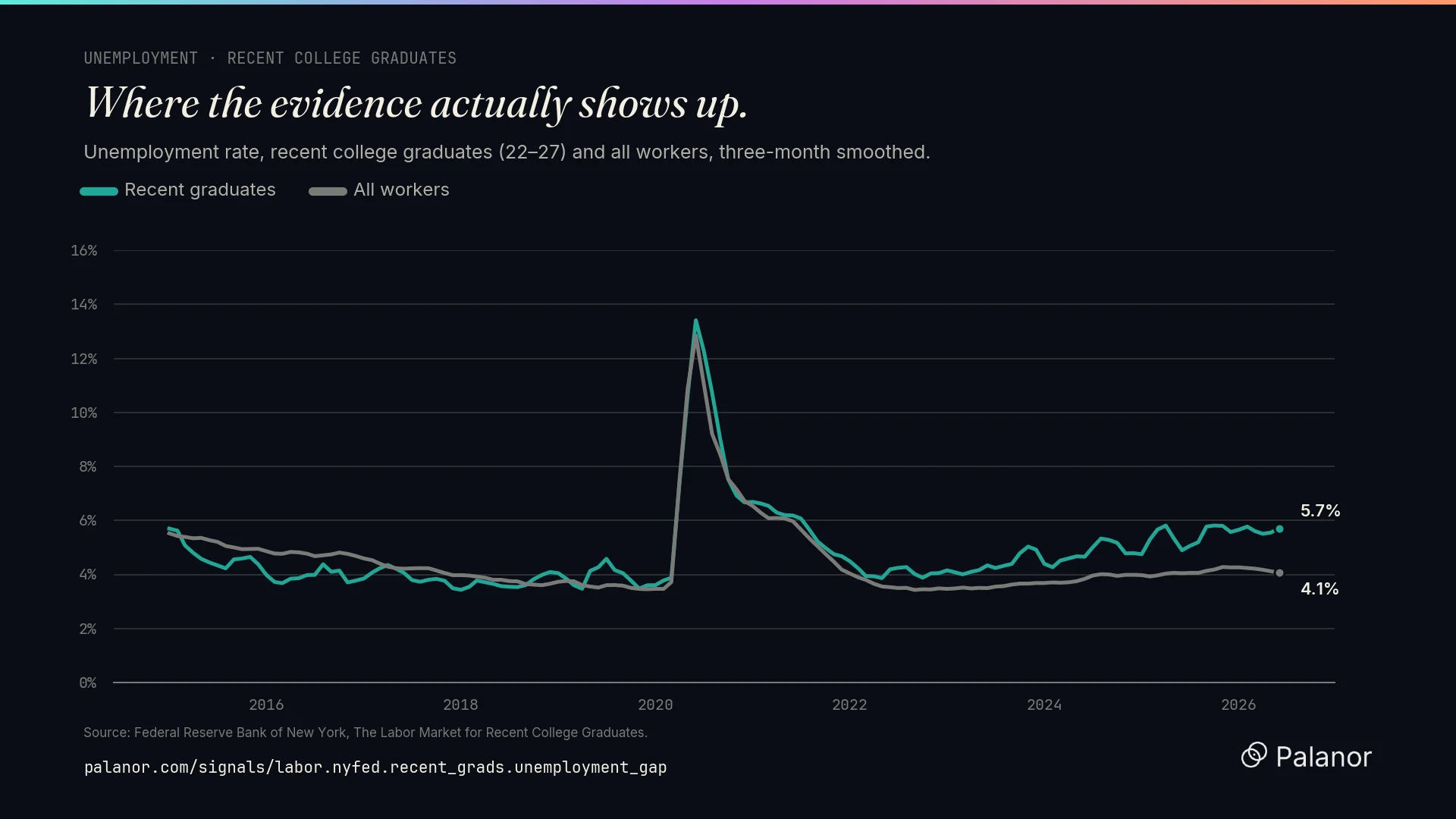
If AI is replacing work, the first people to feel it should be the ones trying to get in the door: young graduates competing for entry-level office jobs, the kind of work AI is best at. The New York Fed tracks them.
Recent college graduates, aged 22 to 27, now have an unemployment rate of 5.7%, against 4.1% for all workers. Before the pandemic, recent graduates were usually unemployed at about the same rate as everyone else, or less. The gap was 0.7 points in mid-2022 and 0.85 in mid-2025. It's 1.6 points now.
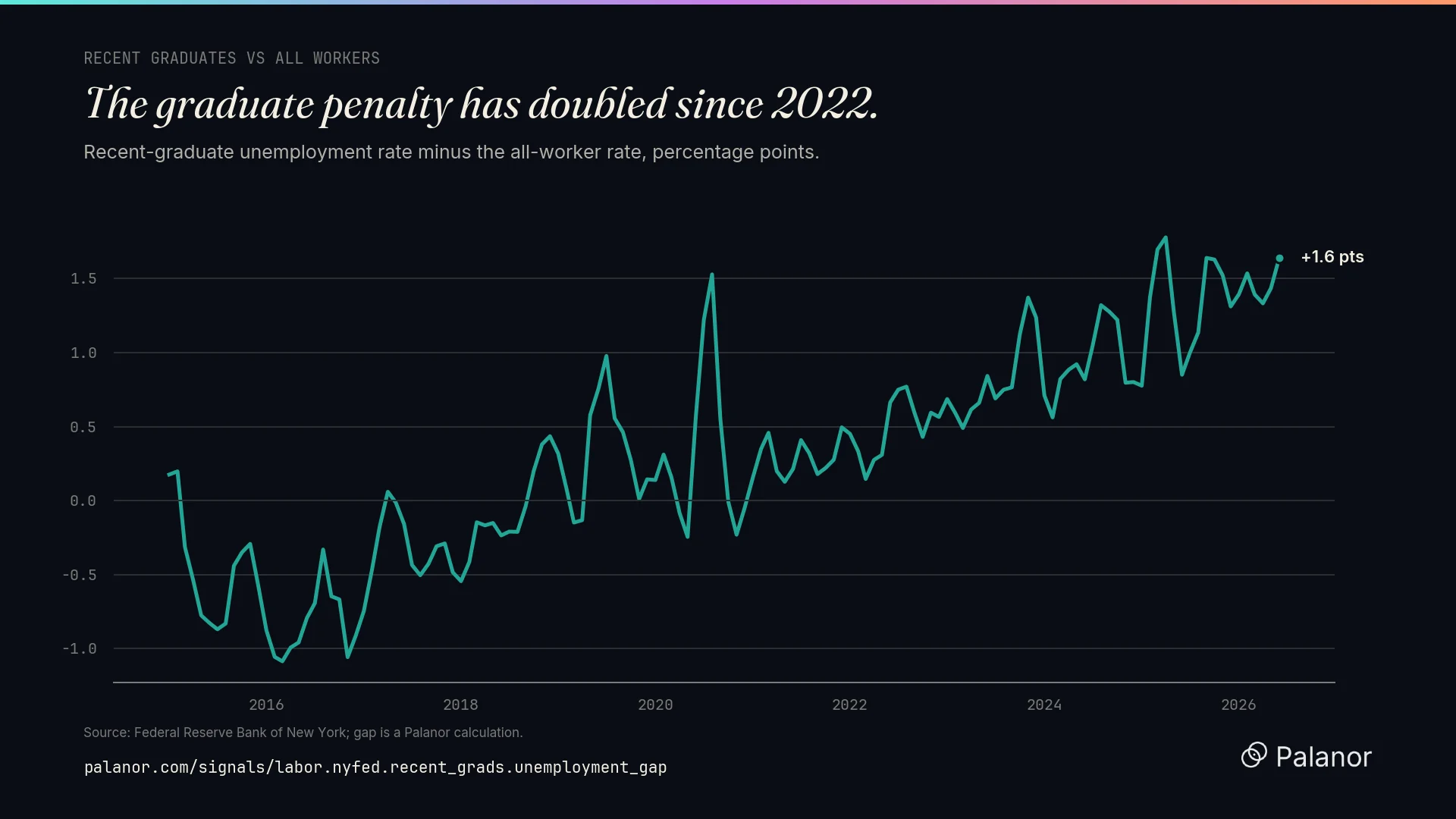
That's real, and worth watching. It isn't proof either. Graduate hiring is sensitive to the economy, and companies cut entry-level hiring first when they get cautious. Part of the gap is that.
Watch the hiring, not the firing.
The honest read: the AI story is louder in announcements than in the data. Where the data does show something, it shows up as doors closing to new entrants, not as people already in work being let go.
What would change this read
Three things. First, the graduate gap widening further while overall unemployment stays flat, which would point at entry-level work rather than the economic cycle. Second, postings for software and other office jobs falling while postings elsewhere hold. Third, AI's share of all announced cuts rising well above its current 5%. We track all three, and we'll report when any of them moves.
The series are live: layoffs blamed on AI, recent graduates' unemployment gap and Challenger's AI-attributed cuts.
References
More in Market Reads
- America cut its aid by more than half. Nobody filled the gap.In 2025 U.S. official aid fell from $65.5 billion to $29.0 billion. Every other source we can measure added about $7 billion. Here is the ledger, and what it says about depending on one funder.
- Earnings calls now read more like ChatGPT. Filings don't.We score every S&P 500 earnings call and annual report. The share of executives' prepared remarks that reads like AI output roughly doubled from 2021 to 2026. The risk-factor sections of the same companies' 10-Ks barely moved.
- Reading the rolling recession.The recession most forecasts called for did not arrive as a recession. It arrived as a sequence — and the sequence is not finished.