

Anthropic just did scenario planning in public. Here's how we'll know which future we're in.
Three futures for the AI economy, two worlds they leave out, the signposts that separate them, and the one number that's already at a record.
By Palanor
Most organizations that talk about the future publish a forecast. A forecast tells you what will happen, and when it's wrong, it's simply wrong. A scenario does something more useful: it tells you what to watch.
Last month Anthropic's economics team published the second kind. Their Econ Scenario Explorer, built on a technical report by Anton Korinek, Chad Jones and colleagues, doesn't say what AI will do to the economy by 2030. It lays out three futures, shows the levers that separate them, and invites you to plug in your own assumptions and see the economy they imply.
That's scenario planning, done honestly and in public, by a company with every incentive to sell one story. We want to give them credit for it, add the piece we think is missing, and then do what scenario planning is actually for: name the signposts and check them against today's data.
What they built
The model treats the economy as a bundle of tasks. AI can help a person do a task, do the task itself, leave it alone, or create a new one. How the economy changes depends on how capable AI gets, how much it does on its own, how much more productive it makes people, how fast companies adopt it, and how long displaced workers take to find new jobs.
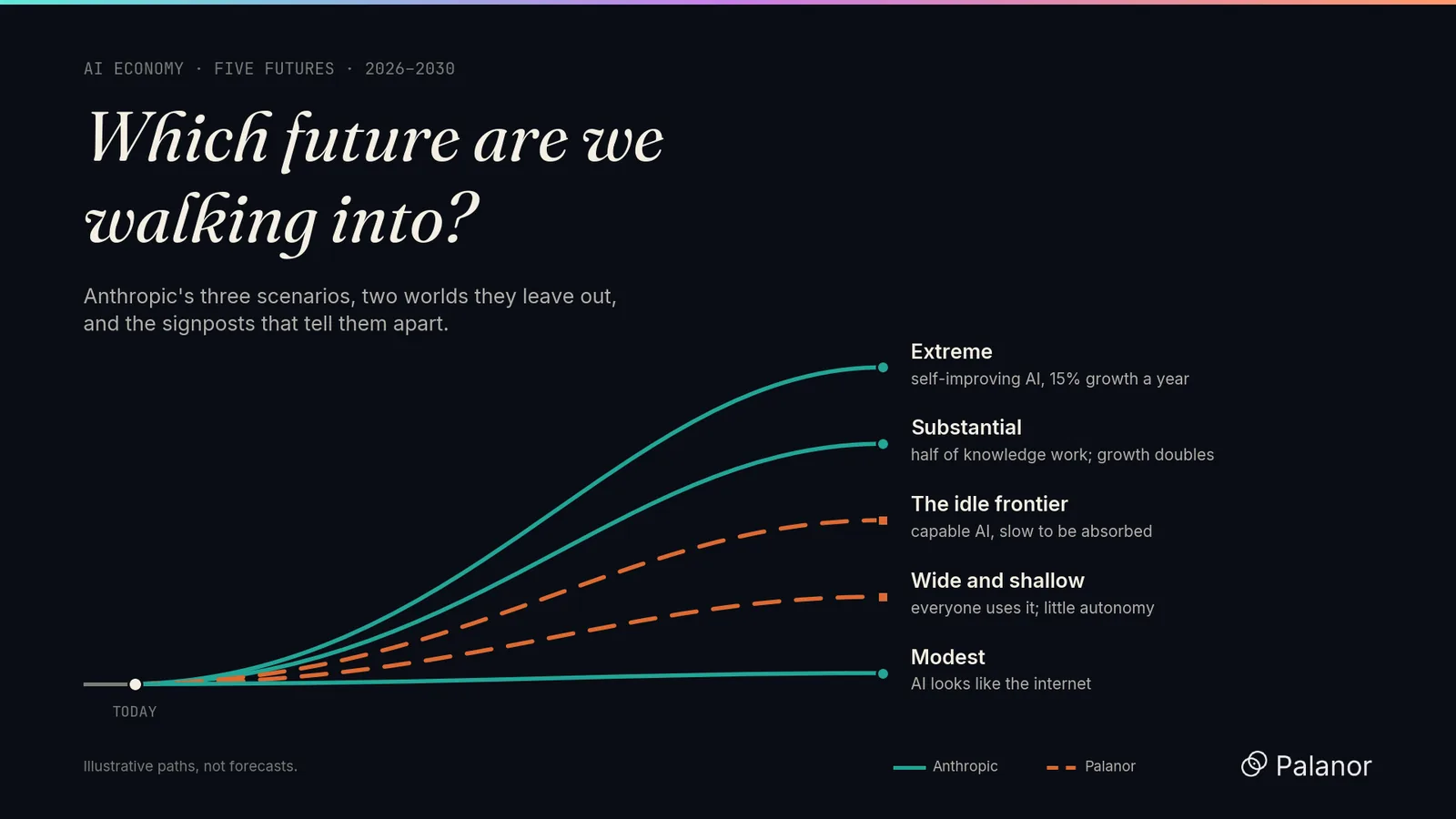
From those levers come three scenarios for 2030:
Modest. AI looks like the internet: real gains, within the historical norm for a new technology, arriving gradually. GDP ends up about 1.6% higher than it would have been without AI. Unemployment stays low. Labor's share of income barely moves, to 59.4 cents of every dollar from about 60.
Substantial. AI can do about half of all knowledge work by 2030, most of it on its own, but most knowledge work still gets done without it. The economy grows at about twice its normal rate and ends up 8.3% larger. Knowledge workers' wages are flat; everyone else's rise. Labor's share falls to 56.1 cents.
Extreme. AI outperforms people at most knowledge work, does it autonomously, and creates few new tasks for people. This probably requires AI that improves itself. Growth reaches 15% a year and the economy is about a third larger by 2030. Unemployment among knowledge workers reaches 17.9%. Their wages fall more than 10%, while other workers' wages rise by a third. Labor's share drops to 45.2 cents.
When Anthropic surveyed more than 10,000 Americans, the typical answer implied something close to the substantial scenario. About one in ten respondents expected the extreme one.
Why this deserves credit
Three things here are rare, and they're the things we'd want any leadership team to copy.
They refused to pick one. "The future is not predetermined" is the line the whole piece builds to. That isn't hedging. It's the right posture when the drivers are genuinely uncertain, and it's the opposite of most AI commentary, which picks a number and defends it.
They showed the levers. You can see exactly which assumptions move you from one future to another. That's what makes a scenario useful for decisions rather than just interesting to read.
They published their critics. The disclaimer names 18 outside economists who reviewed the model and lists what they disagreed with: it doesn't follow individual workers, it leaves out the demand from the data center buildout, it may understate how much AI speeds up research, and the extreme scenario might be better read as a thought experiment. Showing the work, including the parts that don't hold up yet, is how a model earns trust.
Where we'd push
The three scenarios sit on one line. Capability and adoption rise together: modest AI is modestly adopted, and extreme AI is adopted fast. That's a reasonable simplification, but history says the two move separately more often than together.
The electric motor was available for decades before factories reorganized around it. The productivity payoff came when the floor plans changed, not when the motor was invented. The race has usually been decided by adoption, not invention.
So cross the two uncertainties instead of sliding along one, and you get two more worlds worth planning for.
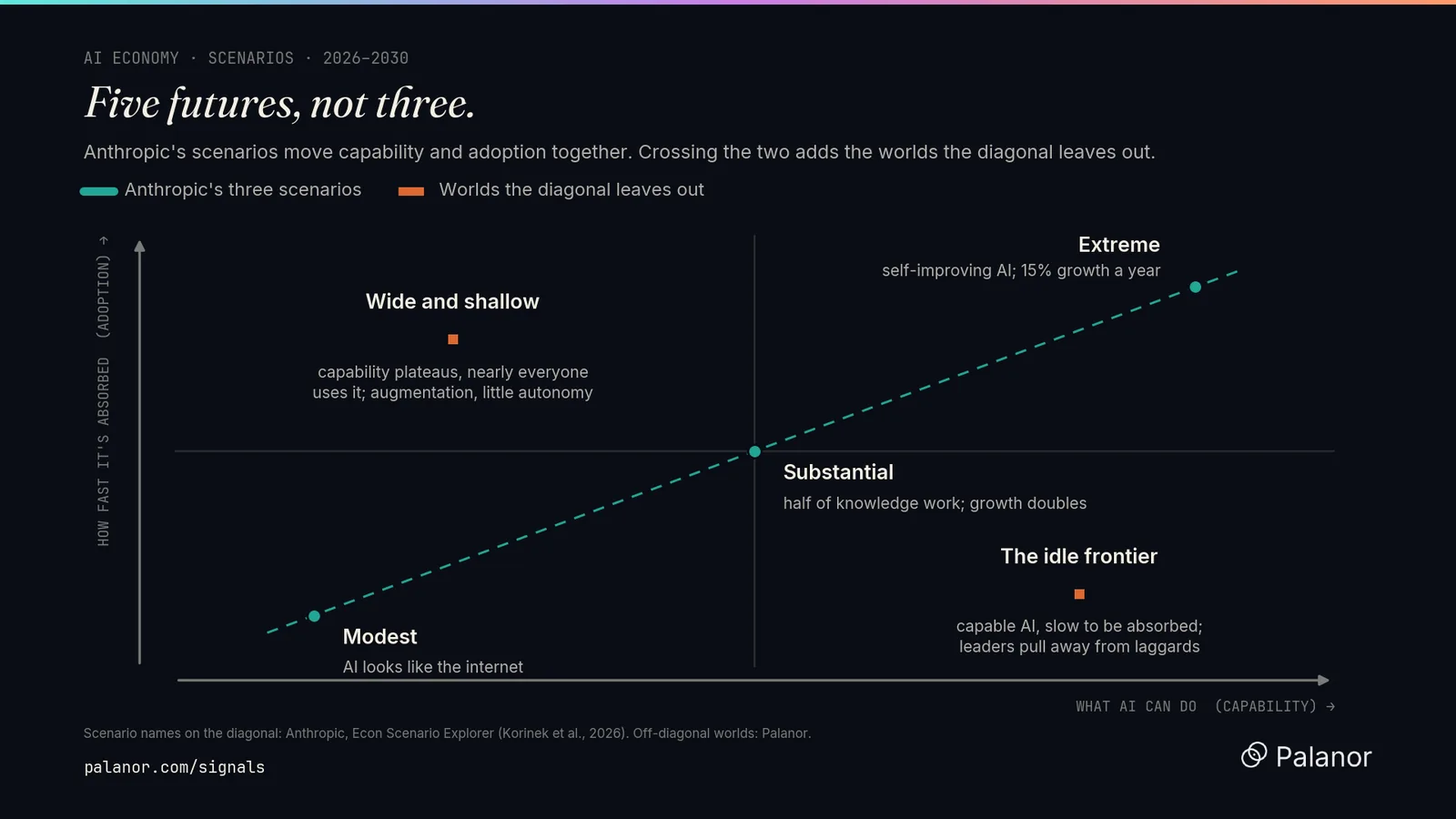
The idle frontier. Capability races ahead, but organizations absorb it slowly. Regulation, liability, culture and middle management hold the line. Labor disruption stays mild, and the gains go mostly to the few firms that rebuild themselves around the technology. The gap between leaders and laggards becomes the story, not unemployment.
Wide and shallow. Capability plateaus near where it is, but nearly everyone uses it. Lots of augmentation, little autonomy. Productivity rises steadily, wages hold, and the labor market barely notices.
Anthropic's substantial scenario gestures at the first of these, with AI able to do half of knowledge work while most of it is still done the old way. Making it explicit matters, because you'd prepare for the idle frontier very differently than for the extreme scenario, even though both start with the same technology.
The signposts
A scenario set is only as useful as the signals that tell you which future you're walking into. Here's how we read it. The thresholds are our interpretation of Anthropic's numbers, not theirs. Every signal below is live and public on Palanor, and updates on its own.
The levers
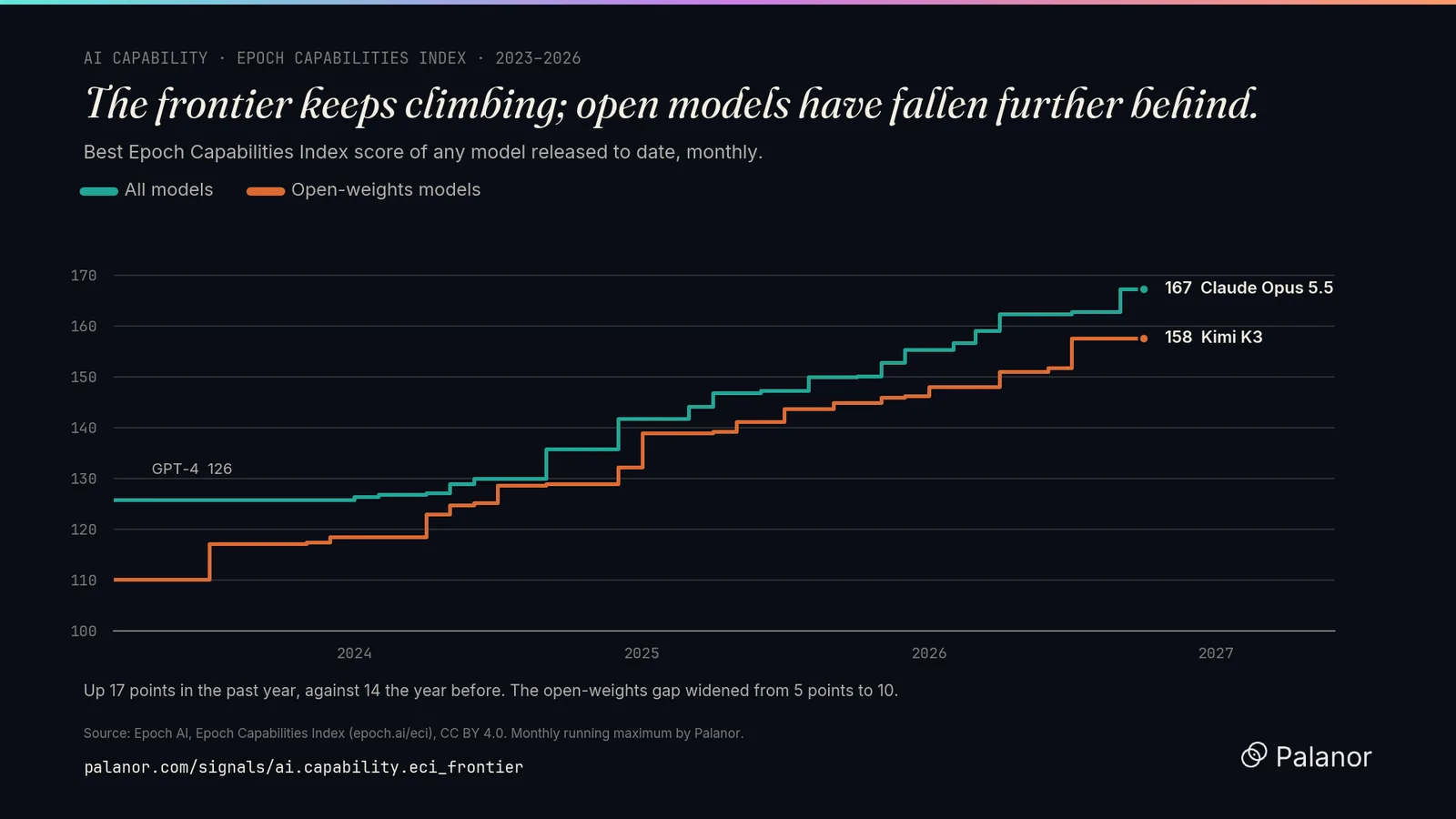
Capability. Epoch AI combines about 40 benchmarks into one capability score per model. The best score of any released model has climbed from 126 (GPT-4, March 2023) to 167 (Claude Opus 5.5, September 2026). It rose 17 points in the past year, a little faster than the 14 points the year before. The best open-weights model, Kimi K3, sits at 158, and the gap between open and closed models has widened from about 5 points a year ago to about 10. Today: steady, slightly faster progress. Consistent with substantial; nothing yet that looks like self-improving AI.
A second read on capability comes from METR, which measures how long a task (in human expert time) AI agents can complete half the time. Its latest measurement puts the frontier above 17 hours (Claude Mythos Preview, April 2026), with that horizon doubling roughly every four months since 2023. METR cautions that its current tasks can't measure much beyond 16 hours reliably, so read that number as "past the edge of the ruler", not as a precise figure.
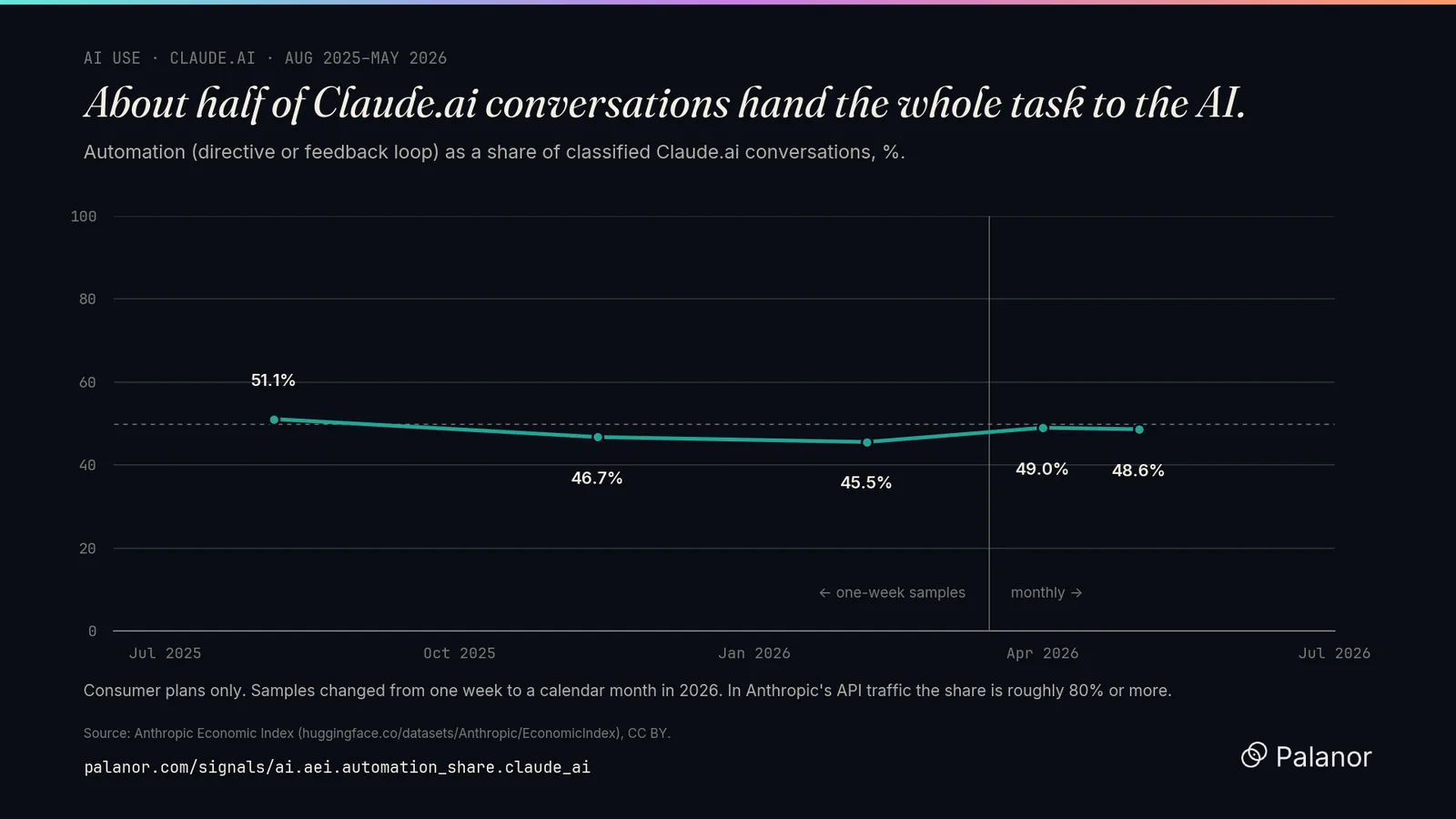
Autonomy. The extreme scenario needs AI doing whole tasks on its own, not helping people with them. Anthropic's own Economic Index measures exactly this in Claude.ai conversations: what share hand Claude the whole task versus working through it together. It has stayed near half for a year: 51% in August 2025, 49% in May 2026. In Anthropic's API traffic, where businesses wire Claude into their own systems, the share is far higher, roughly 80% or more in every release. Today: delegation is real but not rising in consumer use. Watch the business side.
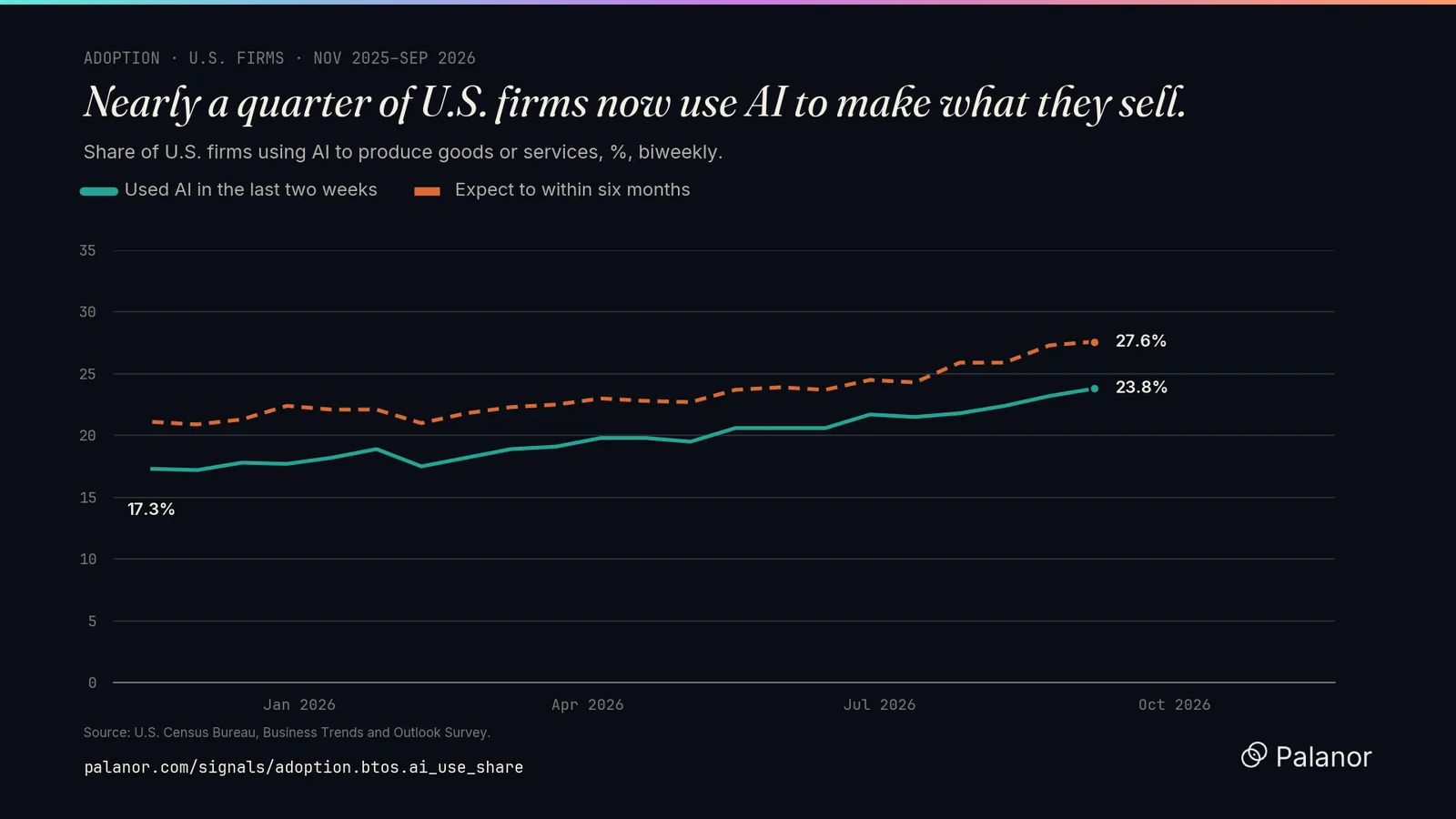
Adoption. The Census Bureau's business survey shows 23.8% of U.S. firms using AI to produce goods or services, up from 17.3% last November. Firms expect 27.6% within six months. That's fast for a business technology and slow next to the extreme scenario, which needs knowledge work adopted quickly and broadly. Today: between modest and substantial.
The economy
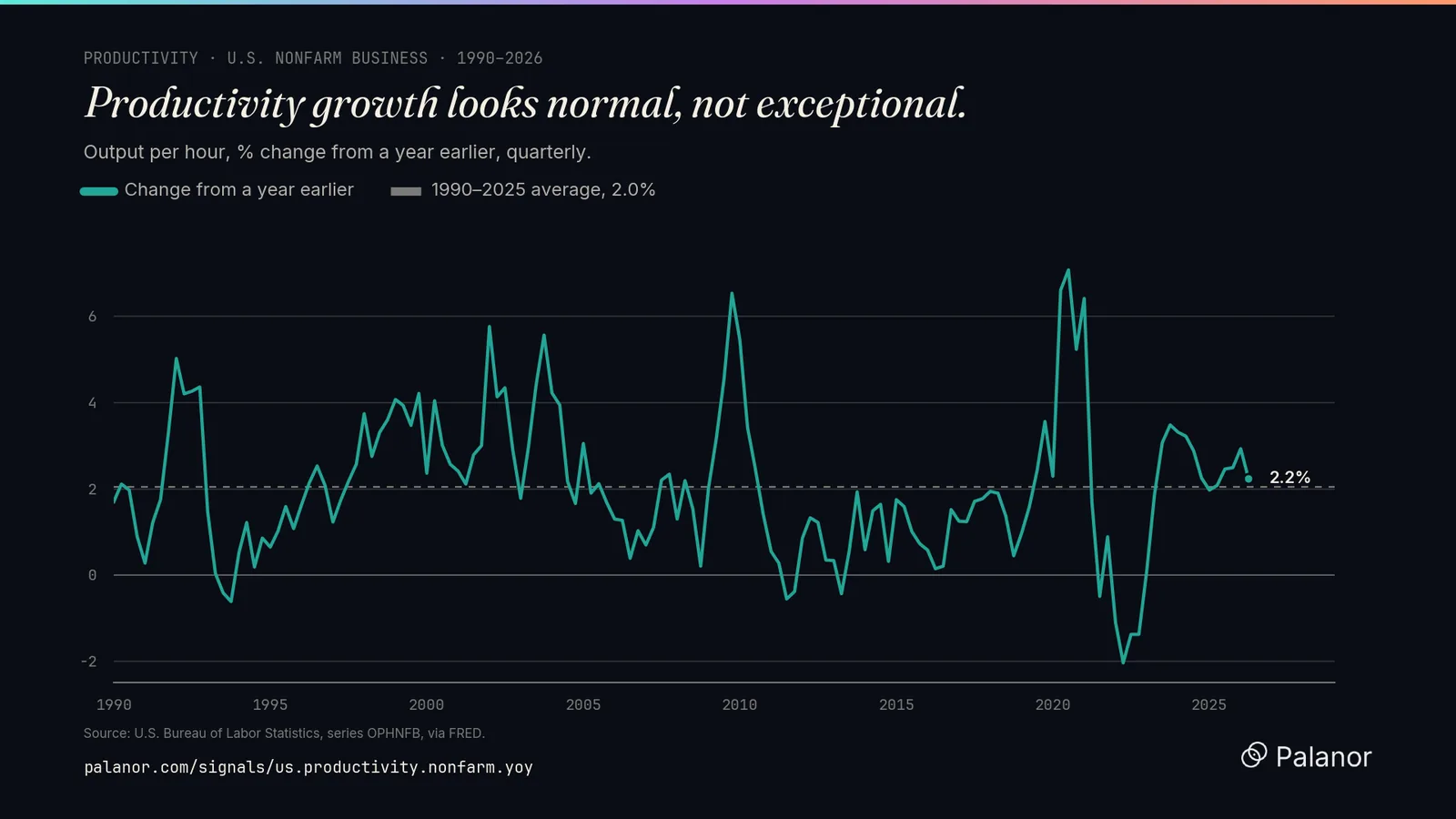
Productivity. Output per hour in nonfarm business was 2.2% higher in the second quarter than a year earlier, almost exactly its 1990–2025 average of 2.0%. A move toward the substantial scenario should show up here first, as several years well above 3%. Today: modest.
Growth. Real GDP grew at a 2.2% annual rate in the second quarter. The Atlanta Fed's GDPNow estimate for the third quarter is 5.1%; the New York Fed's is 2.5%. Modest looks like 2% to 2.5% sustained. Substantial looks like 4% sustained for several years. Extreme looks like nothing in the post-war record. Today: modest.
The labor market
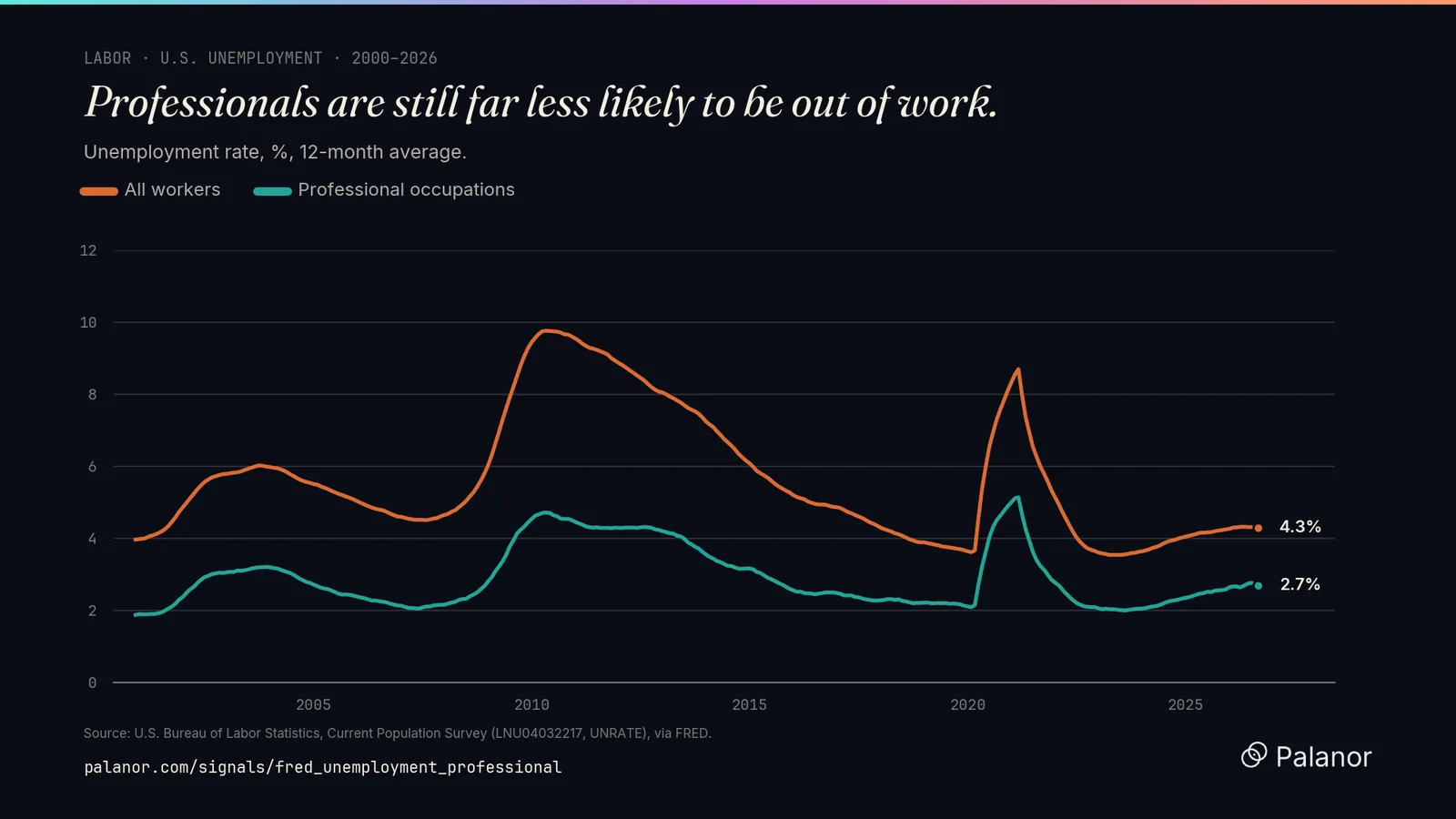
Knowledge-work unemployment. The unemployment rate for professional occupations was 2.6% in September, against 4.2% overall. It rose from 1.9% in September 2022 to 2.8% in September 2025, then eased. In the extreme scenario, knowledge workers end up with higher unemployment than everyone else. Today they're well below it. Today: modest, with a rise that stopped.
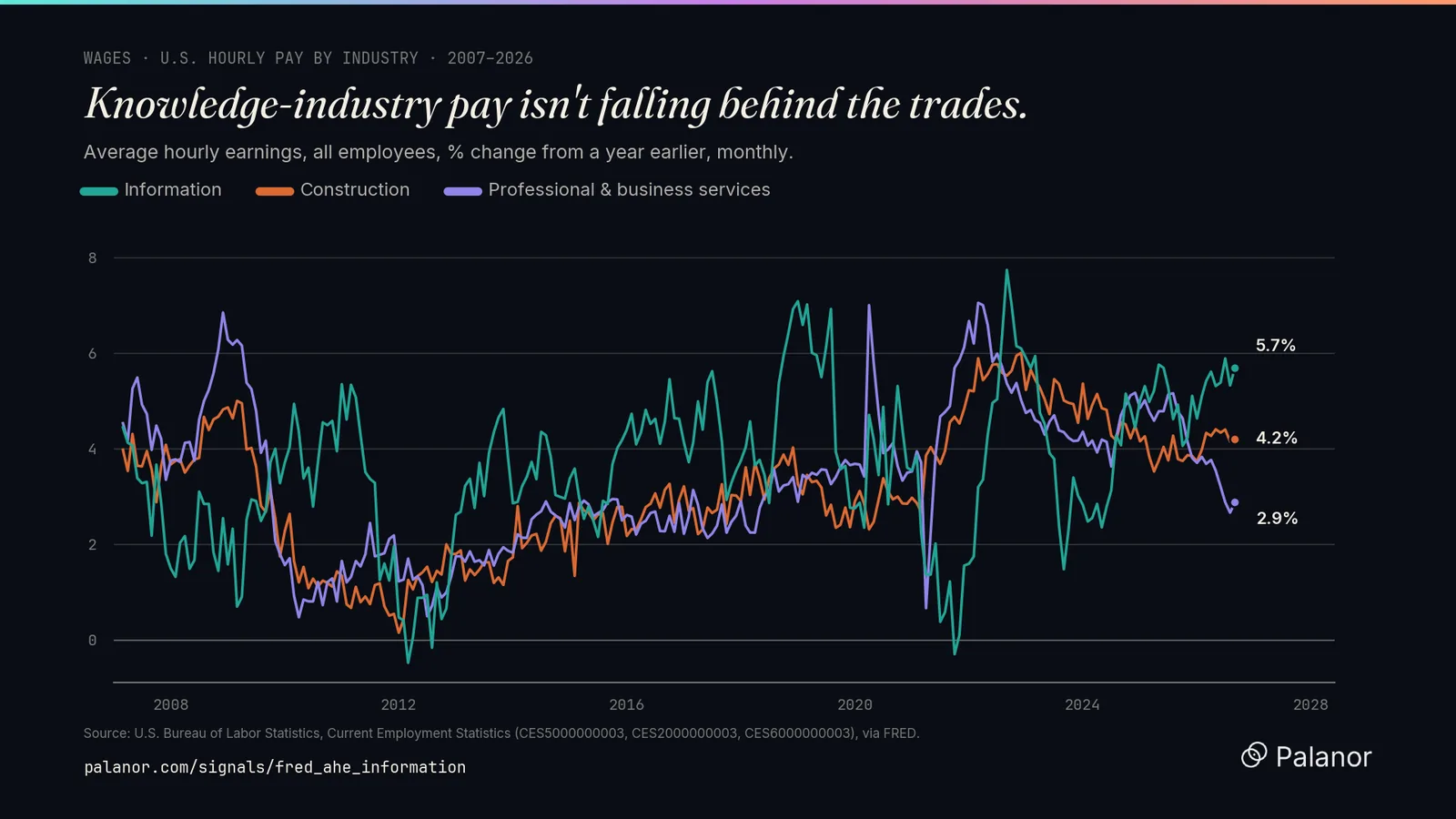
Knowledge pay versus trades pay. This is the cleanest test in the model: in the substantial and extreme scenarios, pay for hands-on work pulls ahead of pay for desk work. It isn't happening. Average hourly earnings in information rose 5.7% over the year to September; in construction, 4.2%; in professional and business services, 2.9%. Today: modest. Professional services, slowing all year, is the one to watch.
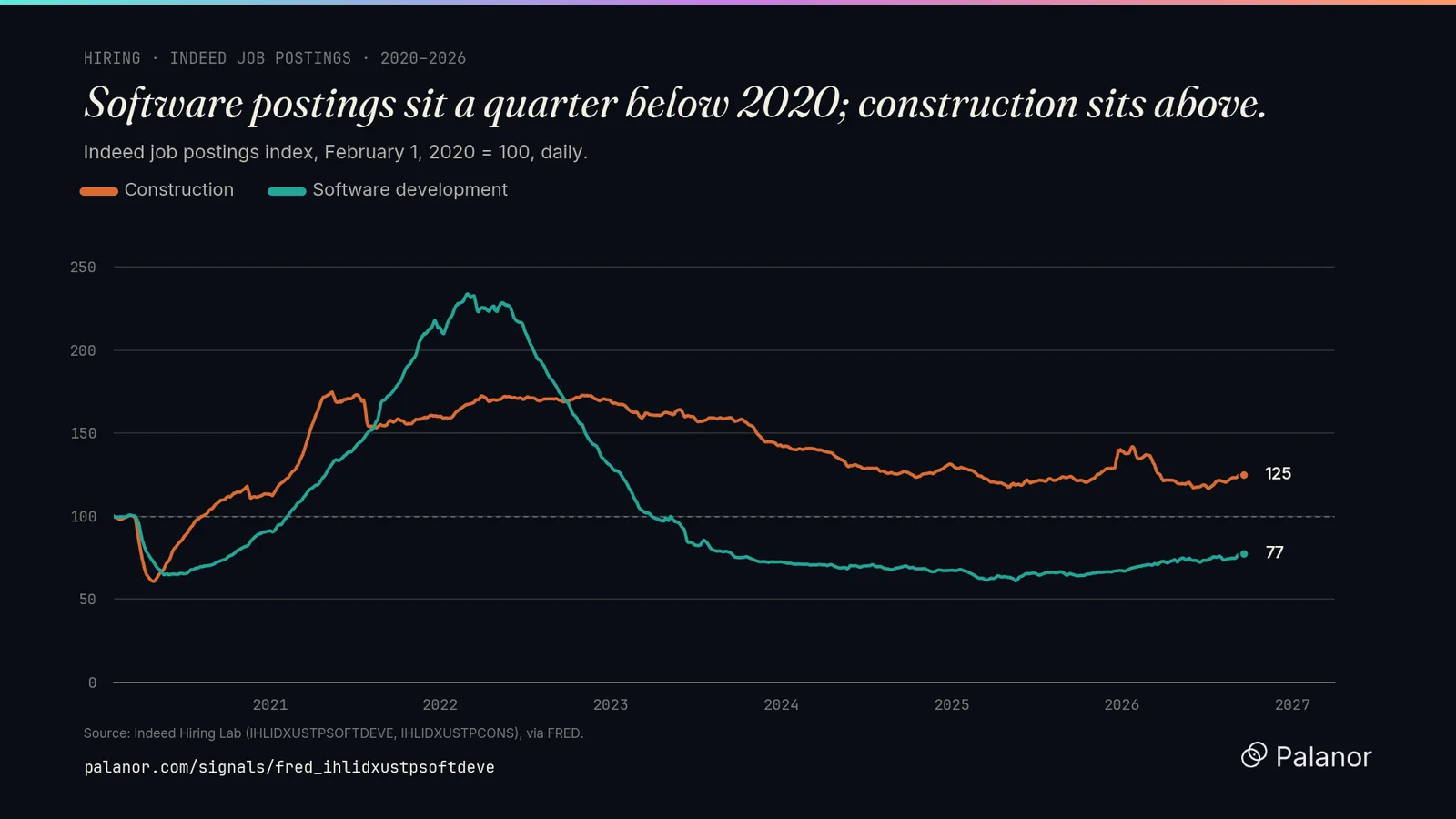
Where the jobs are. Payrolls at computer systems design firms are down about 32,000 over the year, a 1.3% drop. Indeed's index of software development job postings sits at 77, nearly a quarter below February 2020, while construction postings sit at 125. That divergence is the shape the substantial scenario describes, though high interest rates and the post-pandemic tech correction explain much of it. Today: early fingerprints of substantial.
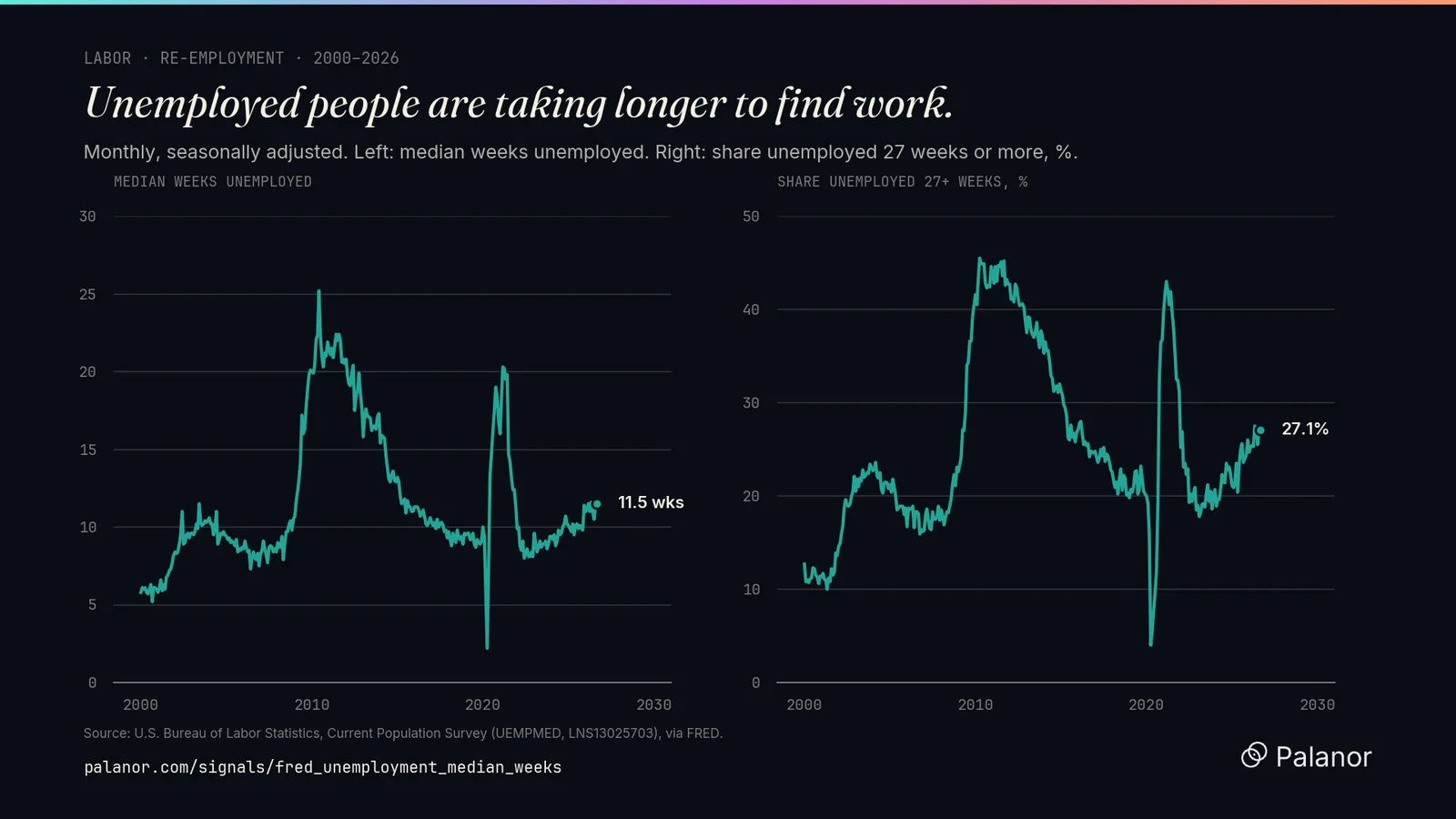
How fast displaced workers land. This is the lever Anthropic surveyed people about, and it's moving the wrong way. The median unemployed person has been looking for 11.5 weeks, up from 10.1 a year ago. The share out of work for more than six months rose from 23.6% to 27.1%. And people's own expectation of finding a new job within three months if they lost theirs (New York Fed Survey of Consumer Expectations) is near the lowest since that survey began in 2013. Today: drifting toward substantial.
The split between labor and capital
Here's the number that stopped us. The Bureau of Labor Statistics' measure of labor's share of nonfarm business output fell in the second quarter of 2026 to its lowest reading since the series began in 1947. It has fallen for five straight quarters.
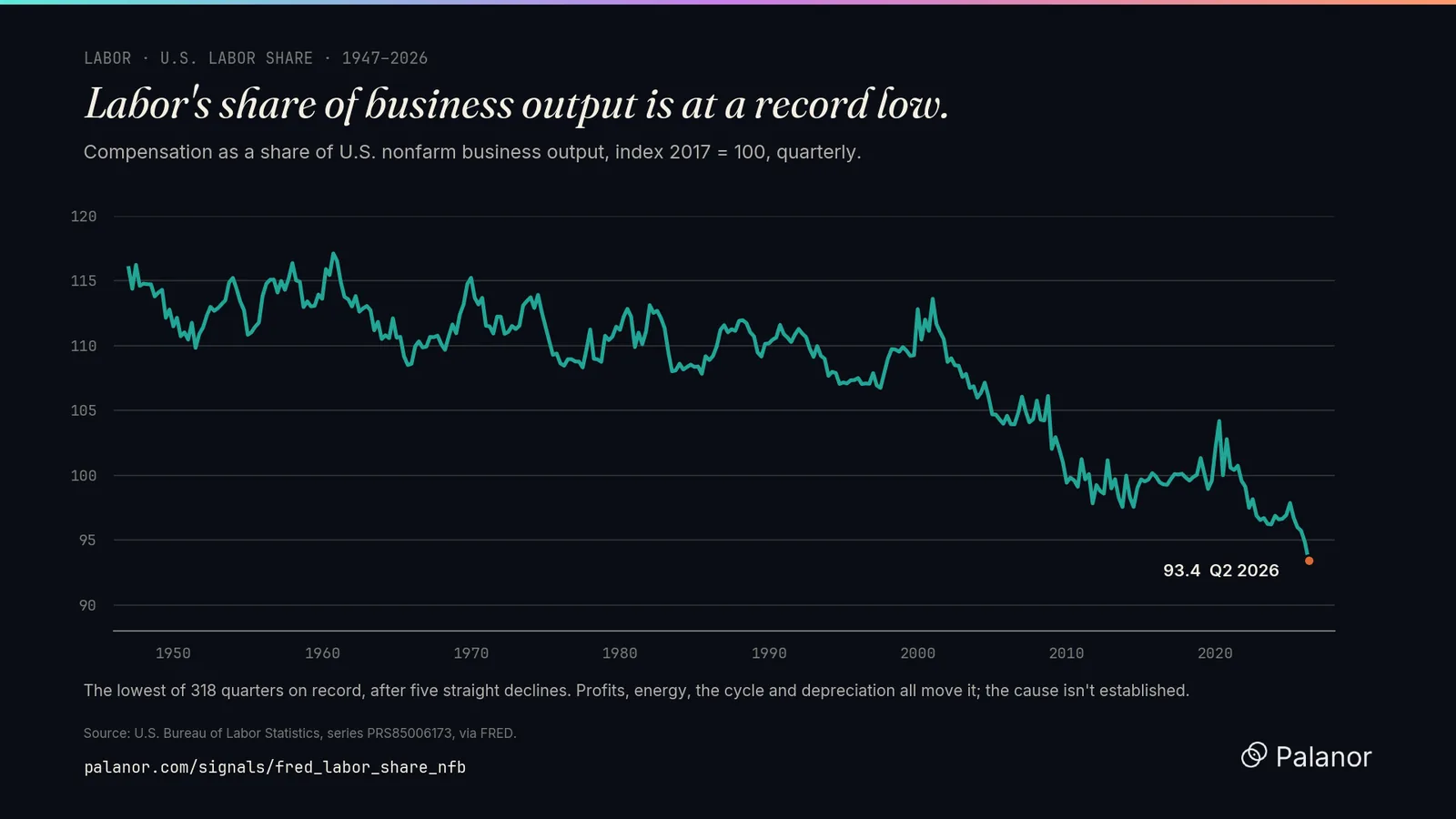
Anthropic's model says a falling labor share is the signature of the substantial and extreme scenarios: the economy grows, and more of the gains go to capital than to paychecks. We want to be careful here. Profit margins, energy, the business cycle and the depreciation of all that new equipment move this number too, and nothing in the data says AI caused it. But it's the signpost the model points to, and it's at a record. Today: substantial's direction, cause unproven.
Building AI versus using it
One more thing, which Anthropic's reviewers flagged. Microsoft, Alphabet, Amazon and Meta put about $511 billion into capital spending over the past 12 months, $219 billion more than the year before. That spending lifts GDP now, whether or not AI ever raises anyone's productivity. When growth looks strong, separate the economy that's building AI from the economy that's using it.
Where that leaves us
As of October 2026, the economy mostly reads like the modest scenario. The substantial scenario shows up in three places: a record-low labor share, slower re-employment, and software jobs falling while trades hold up. Capability keeps climbing, a little faster than last year. Nothing in the data looks like the extreme scenario: knowledge workers aren't losing jobs faster than everyone else, their pay isn't falling behind the trades, and on Claude.ai, people aren't handing off a growing share of their work to AI.
If we had to place the economy on the 2×2, we'd put it closer to the idle frontier than to any point on Anthropic's diagonal: capability is moving faster than the economy is absorbing it.
That's not a forecast. It's a reading, and it'll change.
The point of a scenario set isn't to bet on one future. It's to decide in advance what you'll do if the signposts start lining up, so you aren't deciding in the moment.
If we ran a company that employs a lot of knowledge workers, we'd write down three tripwires today:
1. If professional unemployment rises above the overall rate, revisit the hiring plan for junior roles.
2. If construction and trades pay outruns professional pay for two straight quarters, revisit the compensation bands.
3. If the labor share keeps falling while productivity growth stays normal, ask whether your own gains are reaching the people doing the work, because that's the gap where trust erodes.
Foresight isn't about being right. It's about seeing sooner so you can steer. Anthropic gave everyone a good map. The work now is reading the road.
We'll check these signposts every quarter and publish what moved.
Disclosure: Palanor builds on Anthropic's Claude models. Anthropic had no role in this piece.
References
- First published on Palanor's Substack, October 5, 2026
- Anthropic, Econ Scenario Explorer
- Anthropic Economic Index data (CC BY)
- Epoch AI, Epoch Capabilities Index (CC BY 4.0)
- METR, time-horizon measurements
- Bureau of Labor Statistics, Bureau of Economic Analysis, Census Bureau, Indeed Hiring Lab and the Federal Reserve Bank of New York, via FRED
- Every signal in this piece, live on Palanor
More in Predictive Planning